
Sinking Pool Repair Recommendations
When you come to the sinking realization that your pool is settling, it can bring waves of chlorinated stress:.


When you come to the sinking realization that your pool is settling, it can bring waves of chlorinated stress:
- The summer BBQ pool parties are in jeopardy
- No more cowabunga cannonballs
- No more pink-flamingo-inflatable-floaties
And, worst of all, there goes your property value. But don’t worry!
Just like with foundation settlement and foundation heave, there are viable solutions to address a sinking swimming pool.
This article is going to walk you through:
- Your Pool’s Number One Arch Nemesis
- Pool Repair Strategies
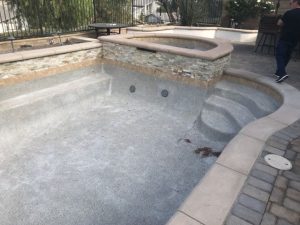
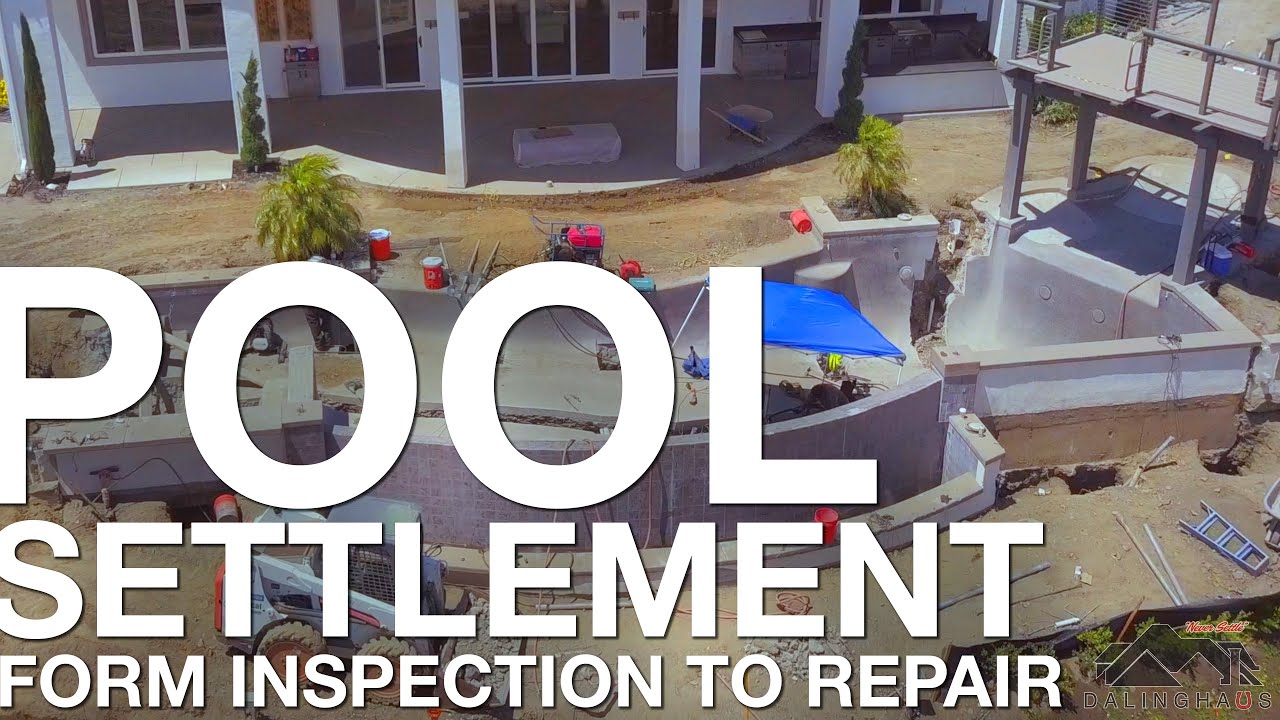

Your Pool’s Number One Arch-Nemesis: Expansive Soil
Typically, a pool doesn’t sink all of a sudden. This a gradual phenomenon that occurs over an extended period of time.
Remember, geological time is like watching molasses drip in Michael Bay slow-motion.
Pool settlement is very similar to when a home experiences foundation settlement because both are due to expansive soil.
In addition, a pool’s settlement can be a simple fix if acted upon early or it can lead to a more complex repair if it is left for an extended period of time.
The general rule of settlement, the longer you wait, the more involved (and, consequently, expensive ) your foundation/pool repair will be.
This is because the soils are either (1. Not properly compacted prior to the pool being built or (2. They’ve become compromised/weakened over time due to water intrusion from weather, the pool itself, or a leaky pipe.
Regardless of how the soils are compromised, the reason why is always directly due to the soils/clays below the pool moving to some degree. Dirt is always in motion.
The soils under your pool can either move vertically and cause a portion of the pool to settle in that area. Or the soils can move laterally, if the pool is constructed on a slope/hill.
Pool Repair Strategies
Depending on the type of settlement (vertical or lateral), this will determine the recommended repair for the pool to impede further movement.
The most common repair recommendation to address a settling/sinking pool is to utilize a series of helical piers and helical tiebacks/anchors.
Helical piers are utilized to impede any further vertical settlement and helical anchors are utilized to impede any additional lateral movement.
If your pool is located on a relatively flat lot, it will not require the use of helical anchors and will be easily stabilized utilizing helical piers.
The implementation of the helical pier system is dependent on the area of the pool that is experiencing movement (as well as the terrain in which the pool is located).
A pool that is located on flat terrain, for example, will typically require 1 of 2 repair recommendations depending on the design of the pool’s shell/foundation.
The pool can be stabilized by going through the bottom of the pool or it can be stabilized by supporting the exterior pool wall.
Pools that are constructed with a spread footing positioned towards the top of the pool allow you to utilize the footing by attaching a support bracket to it.
- Note, this support bracket is remarkably similar to the one that we typically utilize on a home’s foundation during a lift to maximum practical recovery.
The other option for the exterior stabilization approach is to attach flush mount brackets to the shell of the pool, utilizing anchor bolts to support that area of the shell. The spacing of these brackets will be predicated by the loads that are calculated for the pool.
The greater the load, the closer the piers will have to be spaced to properly account for the load. The photo below does an excellent job displaying one of our recent pool repairs.
Installing helical piers and anchors through the bottom of the pool is most commonly used when the pool has experienced both vertical and lateral movement.
It is also the most common repair recommendation based upon the overall construction and amount of movement that the pool has experienced.
This repair involves cutting through the lower portion of the pool’s shell. The cut-out is typically 2-3 feet in width and runs the lower length of the pool with a typical length of 15-20 feet.
The concrete/gunite is removed from the area and then the soils below are excavated out approximately 2 feet. Once the soils have been removed, the helical anchors are installed within the new grade beam.
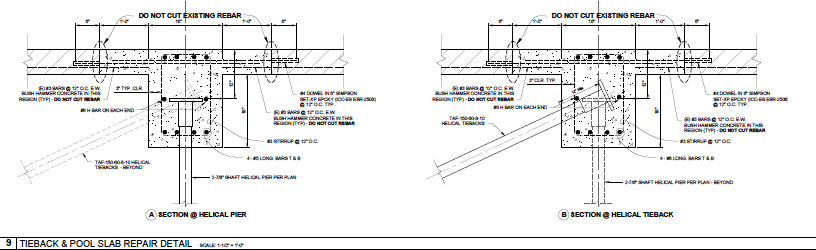
Both vertical and horizontal helical piers and anchors are installed within the grade beam. These piers and anchors are going to be what the load of the pool is transferred to instead of just the pool shell.
Once the anchors and piers are installed, a new grade beam is constructed utilizing a rebar cage. Previously cut rebar within the pool shell is reconnected and then the grade beam is poured with high strength concrete.
Once the concrete is cured, the pool finishes are added back, just like when it was first constructed.
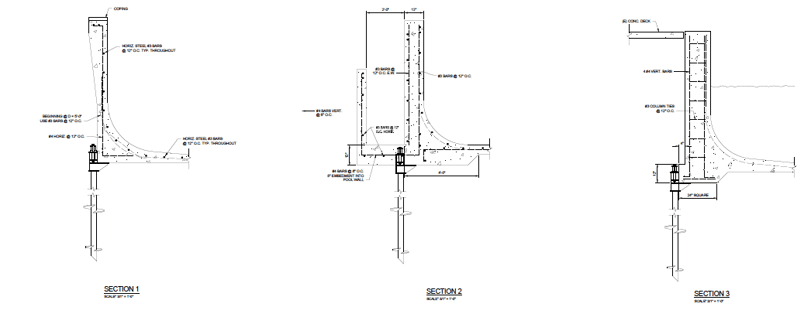
The photo below shows the construction design of the helical pier and anchor grade beam for your average pool stabilization.
Dalinghaus Can Save Your Summer
Pool repairs are definitely not an easy fix and we strongly recommend that you get a consultation from a company that has experience in repairing pools.
If the repair is not designed properly, then you could end up having to repeat the repairs down the road.
We don’t want you to lose access to your beautiful pool, especially in our unforgiving Southern California and Central Arizona summers.
If you don’t live in our backyard but are an avid reader of our blog, give us a shoutout on your general contractor blog/push pier enthusiast Reddit board or drop us a line in the comment section. We appreciate you!
Or if you require a different service, check out these other articles of services we provide. :
Read our case study: Saving Diamond Bar Pool with Helical Piers
Schedule a Free Evaluation
Foundation movement is easier to judge in person than from a photo. Schedule a free evaluation and a Dalinghaus specialist will walk the property with you and explain what the evidence shows.
Written by
Brian Dalinghaus
Co-Founder, Dalinghaus Foundation Repair
Brian Dalinghaus founded Dalinghaus Foundation Repair with his brother Brad in Southern California in 2011. The brothers built the company on a Midwest work ethic and a single standard for every job: Never Settle.
More about Brian