
Uneven Concrete Driveway Repair Using Polyjacking
Searching for information about concrete driveway repair? If so, don't hit that back button because you've landed on the right page.

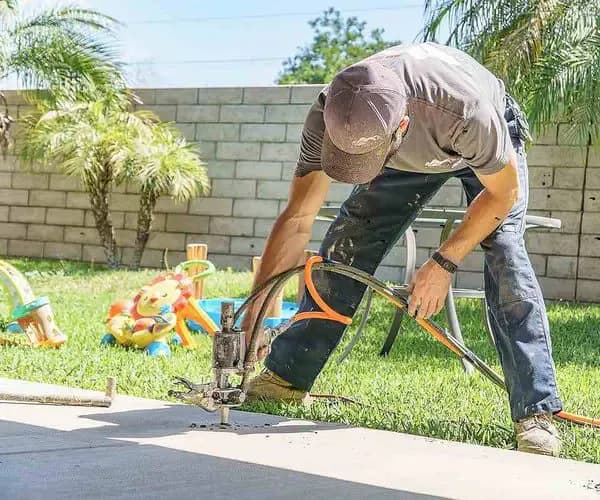
Searching for information about concrete driveway repair? If so, don’t hit that back button because you’ve landed on the right page. In this article, we’re going to go over why concrete driveways become uneven, how polyjacking can quickly fix the problem, how concrete driveway repair is performed using polyjacking, and more.


Why Concrete Driveways Become Uneven
Concrete driveways become uneven due to a variety of reasons, including the following:
- Expansive soil, Soil that contains a high percentage of clay expands as it absorbs moisture and then shrinks as it releases moisture and dries out. This causes movement in the ground under the foundation and can, over time, cause a driveway, or any other concrete slab, to become uneven.
- Erosion-prone soil, Other types of soil are prone to erosion. This can cause voids to form; if the driveway settles into the voids, it will become uneven.
- Poor installation, If the ground underneath the driveway wasn’t adequately prepared or the concrete wasn’t correctly mixed, it can lead to unevenness and cracking.
- Heavy traffic, Large vehicles can also contribute to the deterioration and eventual unevenness of the driveway.
- Extreme weather conditions, The freeze-thaw cycles can take a toll on concrete driveways and cause them to become uneven. When water seeps into the pores of the concrete and then freezes, it can expand and cause cracking and unevenness.
- Tree roots, Nearby trees with large roots can grow underneath the driveway and cause it to shift and become uneven. Tree roots can also “drink” water from the soil, leaving behind voids.
- Drought, Lack of moisture can cause clay-rich soil under the driveway to shrink.
- Seismic events, We probably don’t need to explain how earthquakes can cause an uneven driveway.

While some of these factors are unavoidable, proper installation and maintenance can help prevent or mitigate the issue. Regular cleaning, sealing, and crack repair can extend the life of the concrete and prevent it from becoming uneven.
What Is Polyjacking?
Polyjacking is a way to fix an uneven driveway (or other concrete slabs) without digging up and replacing the slab. It involves injecting polyurethane foam, a synthetic resin material, underneath a concrete slab to lift it back into its proper position and stabilize it. This technique is commonly used to address uneven or sinking concrete slabs such as driveways, sidewalks, patios, etc.
Concrete Driveway Repair: Mudjacking vs. Polyjacking
If you’ve been looking for information about concrete driveway repair, you’ve probably run across the term “mudjacking.” Polyjacking and mudjacking are the two primary methods of concrete leveling. Both involve drilling holes into the affected driveway, sidewalk, patio, etc., and then pumping a material underneath to lift and level the slab.
Mudjacking is the old-school method of lifting and leveling an uneven driveway. It uses cement slurry (mud, sand, and cement) to raise the slab.
Polyjacking uses a newer technology that injects expanding polyurethane foam under the uneven driveway via small, dime-sized holes drilled into the concrete slab. The foam expands to fill any voids beneath the driveway, lifting and leveling it.

The Benefits of Polyjacking to Level an Uneven Driveway
While both polyjacking and mudjacking are effective in leveling concrete driveways, polyjacking has become the preferred method in recent years due to its numerous advantages:
- Polyurethane foam is significantly lighter than the mud, sand, and cement mixture used in mudjacking, which puts less stress on the soil below the slab.
- Polyjacking is far less invasive than digging up and replacing an uneven driveway.
- Polyjacking is significantly faster than mudjacking. Most concrete driveway repair jobs using polyjacking take only a few hours tops, and then the driveway is ready for use again. In contrast, the cement slurry used in mudjacking needs several days to cure.
- The lightweight polyjacking foam also creates a more even lift, resulting in a smoother and more level surface overall.
- Polyjacking produces a better-looking repair than mudjacking because the holes used to pump the foam under the driveway are smaller.
- Furthermore, polyurethane foam is waterproof and won’t break down over time like the cement slurry used in mudjacking. This means that concrete lifted using polyjacking will be more durable and require less maintenance in the long run.
- The foam used in polyjacking isn’t susceptible to erosion like the cement slurry used in mudjacking.
Concrete Driveway Repair Using Polyjacking Is Not a DIY Project
Polyjacking is a highly specialized process that requires the expertise of trained professionals. The process involves injecting the polyurethane foam at carefully controlled rates and pressures, which can vary depending on the size and shape of the concrete slab being repaired.
Uneven Concrete Driveway Repair Using Polyjacking
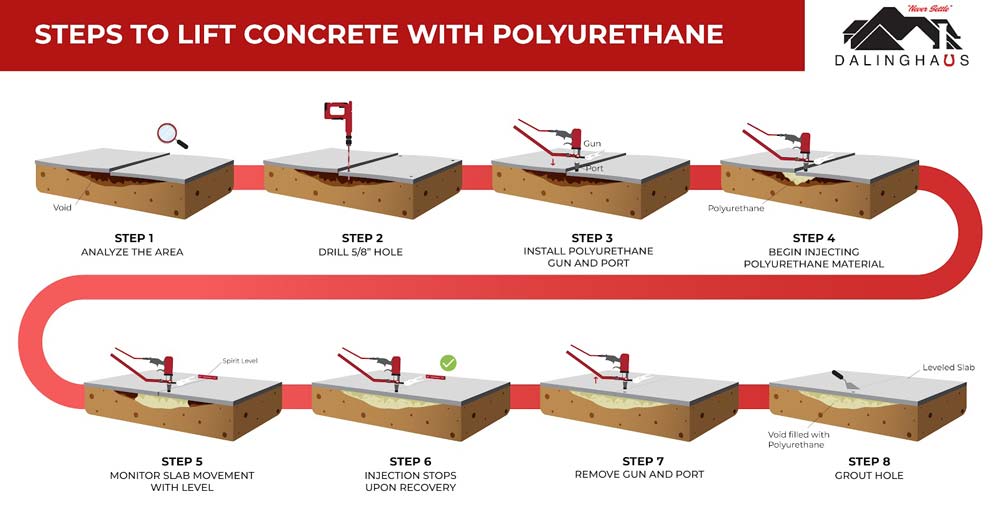
As we noted above, polyjacking is a technique that involves injecting a specialized polyurethane foam beneath the surface of the concrete, which then expands to lift and level it. Here are the steps involved in uneven concrete driveway repair using polyjacking:
Step 1: Inspection
Before the polyjacking process can begin, a thorough driveway inspection is performed to identify the areas that require repair. This involves checking for sinkholes, voids, cracks, and other structural damages that may be present.
Step 2: Preparation
Once the inspection is complete, the affected areas are prepared for the injection process. This involves drilling small dime-sized holes into the concrete, through which the polyurethane foam will be injected.
Step 3: Injection
The polyurethane foam is then injected through the drilled holes. The foam consists of two components, which are mixed using specialized equipment. Once the mixture is injected, it expands and fills any voids beneath the surface of the concrete.
Step 4: Lifting and Leveling
As the foam expands, it lifts the concrete and levels the surface. This is done slowly to avoid causing any additional damage to the concrete. The process continues until the desired level is achieved.
Step 5: Finishing
Once the leveling process is complete, the drilled holes are filled with a concrete patch material to blend in with the surrounding surface. This ensures a seamless finish that looks aesthetically pleasing.
Polyjacking is an excellent solution for repairing uneven concrete driveways that saves time, money, and hassle. The process is simple, efficient and leaves the driveway looking as good as new.
How Much Does Concrete Driveway Repair Cost?
The cost of polyjacking an uneven concrete driveway varies depending on several factors, such as your geographical location, the size of the uneven area (this determines how much foam is required), the accessibility of the site, etc.
It’s important to note that the cost of polyjacking is significantly lower than digging up and replacing a concrete driveway. The only time a driveway would need to be torn up and replaced is when there’s extensive damage.
If you need concrete driveway repair in Southern California, Arizona, or Nevada, contact us today to schedule an evaluation and receive a repair estimate.
Schedule a Free Evaluation
Foundation movement is easier to judge in person than from a photo. Schedule a free evaluation and a Dalinghaus specialist will walk the property with you and explain what the evidence shows.
Written by
Brian Dalinghaus
Co-Founder, Dalinghaus Foundation Repair
Brian Dalinghaus founded Dalinghaus Foundation Repair with his brother Brad in Southern California in 2011. The brothers built the company on a Midwest work ethic and a single standard for every job: Never Settle.
More about Brian