
What Are Concrete Piers? Foundation Support Explained
What drilled concrete piers are, how they are installed, what they cost, and why Dalinghaus installs helical and push piers instead. Schedule a free evaluation.

Your home’s foundation keeps everything stable. However, when the soil shifts from moisture changes or other factors, it can stop carrying the weight above it, which shows up as cracks, uneven floors, and more significant structural problems.
Drilled concrete piers are one of the deep foundation systems engineers use to reach past that soil to ground that can hold the load. This article explains what they are, how they go in, what drives the cost, and how they compare with the two deep foundation systems Dalinghaus Foundation Repair installs on homes, helical piers and push piers.
What Are Drilled Concrete Piers?
According to the book Methods of Foundation Engineering, drilled concrete piers are deep foundation supports made of reinforced concrete. These piers are built by drilling a hole in the ground, adding reinforcement, and filling it with concrete. Its main job is to support heavy loads and transfer weight into stable soil. This prevents further sinking and damage.

Size and Classification
Drilled piers vary in size, but most are at least 0.6 meters (2 feet) in diameter based on engineering standards:
- American Society of Civil Engineers (ASCE): Defines drilled piers as those larger than 0.6 meters in diameter.
- American Concrete Institute (ACI): Sets the minimum diameter at 0.76 meters.
- German DIN 4014,2 Standard: Requires a diameter greater than 0.5 meters.
- Bored piles are foundations smaller than 0.6 meters but serve a similar function. While size is the main difference, there is no strict boundary between the two.
Types of Drilled Concrete Piers
- Straight-Shaft Piers: Used when soil is dense and stable.
- Belled Piers: Have a flared base for extra support in softer soils.
- Socketed Piers: Extend into the rock for maximum stability.
How Do Drilled Concrete Piers Work?
Drilled concrete piers address foundation settlement by bearing on stable soil or bedrock below the layer that moved. Reaching competent ground is where the capacity comes from, and the steps below are how a drilled shaft gets there.
- Site Inspection: Experts check soil type, moisture levels, and foundation damage. They may run a geotechnical survey to find the right depth for the piers.
- Drilling: A powerful drill creates a deep hole based on your soil conditions. If needed, a temporary casing keeps the hole from collapsing. According to the International Building Code, foundation walls, piers, and other permanent supports must extend below the area’s frost line.
- Reinforcement Placement: A steel rebar or cage is added for extra strength, helping the pier handle heavy loads without cracking.
- Concrete Pouring: High-strength concrete fills the hole, securing the steel reinforcement and forming a solid support. This step must be precise to avoid air pockets.
- Curing: The concrete hardens over several days, turning into a strong foundation support.
- Load Transfer: Once cured, the piers connect to your foundation, stabilizing your home. Engineers may test them to ensure they can handle the weight before completing the job.

Reinforced concrete holds up well underground, which is why drilled shafts are common on engineered projects.
Strengths and Limits of Drilled Concrete Piers
Depth is the point of the system. A drilled shaft gets past the surface soils that move and bears on ground that does not. It also carries trade-offs, and those trade-offs decide most residential jobs.
Where they are strong:
- Load capacity: A large reinforced shaft carries weight that lighter systems cannot.
- Designed depth and diameter: Each pier is sized from geotechnical data for the soil and the load at that specific site.
- Durability: Reinforced concrete resists soil movement and holds up well underground.
Where they are limited:
- Labor-intensive installation: The work requires excavation and cure time, so it takes longer than a driven steel system.
- Higher upfront costs: More labor and more material mean a higher initial expense.
- Cleanup required: Drilling leaves displaced soil and debris that has to go somewhere, which is a real problem in a finished side yard.
- No proof as the pier goes in: Capacity comes from the engineer’s calculation and the soils report, not from a reading taken during installation.
- Room to work: A drilling rig, a concrete truck, and a place for the spoils all need space. Most home repair happens in a few feet along an existing footing.
Drilled Concrete Piers vs. Other Foundation Repair Options
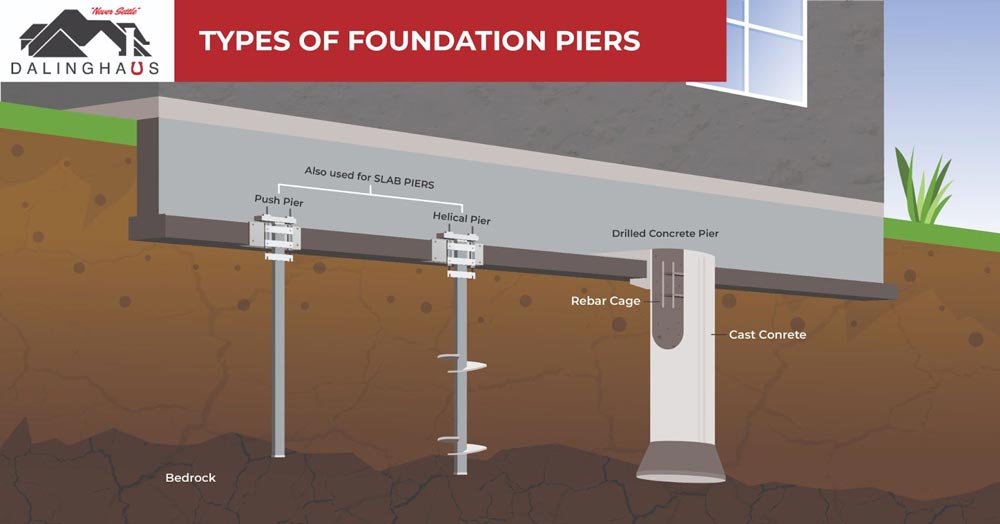
When fixing a sinking foundation, it’s important to choose the right support system. Drilled concrete piers, helical piers, and push piers each serve different purposes based on the soil type, load requirements, and long-term durability. Here’s a table for helical piles vs concrete piers vs push piers:
| Feature | Drilled Concrete Piers | Helical Piers | Push Piers |
|---|---|---|---|
| Construction | Involves drilling deep holes into the ground, inserting steel reinforcement, and filling them with concrete. | Consist of steel shafts with helical plates that are screwed into the ground. | Made of steel pipes driven into the ground hydraulically until they reach load-bearing soil or bedrock. |
| Best For | Heavy structures and areas with unstable or expansive soils. | Lighter structures or situations requiring quick installation. | Heavy structures and multi story homes. |
| Durability | High; designed for long-term stability with minimal maintenance. | Moderate; suitable for various soil conditions but may not be ideal for extremely heavy loads. | Varies; effectiveness depends on reaching suitable load-bearing strata. |
| Installation Time | Longer due to the curing time required for concrete. | Fast; can be installed quickly with minimal disturbance. | Moderate; installation is relatively quick without curing time. |
| Cost | Moderate; while labor-intensive, they offer a durable solution. | Higher due to specialized equipment and materials. | Lower; less labor and material required. |
| Considerations | The installation process is labor-intensive and may require significant excavation, leading to higher costs and more site disruption. | Helical piers are advantageous in areas with limited access and cause minimal disruption to the surrounding landscape. | Push piers are less invasive and can be installed with minimal disturbance, but their long-term effectiveness depends on reaching stable soil layers. |
How Much Do Concrete Piers Cost?
The cost of drilled concrete piers can vary widely based on several key factors.
- Soil Conditions: Piers must be drilled deeper to reach solid ground if your property has soft or unstable soil. This increases material and labor costs. In contrast, stable soil allows for shorter, less expensive piers.
- Pier Depth: Deeper piers require more concrete, steel reinforcement, and drilling time, raising the overall cost. Soil tests and structural requirements determine pier depth.
- Foundation Size and Load: Larger homes and heavy structures need more piers to evenly distribute weight. The more piers required, the higher the total cost.
- Labor Costs: Prices vary based on location, contractor experience, and job complexity. In areas with higher labor rates, expect to pay more for installation.
- Site Access and Excavation Needs: Costs will increase if the work area is hard to access or requires extensive digging. Projects in tight spaces may need specialized equipment, adding to the expense.
- Permits and Engineering Fees: Some regions require permits, soil tests, and engineering assessments, which can add a few thousand dollars to the total cost.
FAQs About Drilled Concrete Piers
How deep do drilled concrete piers need to be?
Drilled concrete piers typically range from 10 to 30 feet deep, but deeper installations may be required for unstable soil or heavier structures. Engineers determine depth based on geotechnical testing to ensure the piers reach stable ground or bedrock, preventing future foundation movement and ensuring long-term support.
Depending on pier quantity, depth, and site conditions, the process usually takes several days to a week. Deeper piers or poor soil can slow drilling. Concrete must cure before supporting weight, adding time. Weather, accessibility, and excavation needs also impact installation speed, requiring careful planning for efficiency.
Are drilled concrete piers better than slab foundations?
They are two different things, so the comparison only goes so far. A slab is the foundation itself, sitting on the soil near the surface. Drilled piers are a support system that carries a foundation down to competent ground. Where the surface soil moves with moisture, a deep system reaches below the layer causing the trouble, which a shallow slab cannot do. Which one belongs at a given property is the engineer’s call, made from a soils report.
Can they be used for home additions and decks?
Drilled concrete piers are often used for additions, decks, and porches that need deep support, particularly where expansive soil or a heavy load rules out a shallow footing. The diameter and depth come from the soils report for that site rather than from a standard detail.
Does Dalinghaus install drilled concrete piers?
No. Our deep foundation work on homes is done with helical piers and push piers. If the evidence at your property points toward a drilled shaft, we will say so and point you to the engineer who should design it.
What Dalinghaus Installs, and Why
Dalinghaus Foundation Repair does not install drilled concrete piers. On homes we use helical piers and push piers, both driven galvanized steel, for reasons that come off the job site rather than out of a brochure:
- The pier reports its own capacity. Installation torque on a helical pier tracks the strength of the soil it is turning into, and a push pier is driven against the weight of the house until the ground resists harder than the structure weighs. Either way there is a number on the day of installation.
- The equipment fits the property. A hydraulic drive head works in a side yard and under a deck, where a drilling rig cannot get in.
- There is no cure time. Load transfers to the steel as soon as the brackets are set.
- Lift is sometimes available. Where the structure can take it, we can lift back toward level during the transfer, which often closes cracks the settlement opened.
Early attention still saves time and money, whichever system a property turns out to need.
Get a free evaluation today! Contact Dalinghaus Foundation Repair and a specialist will look at what your foundation is actually doing.
Schedule a Free Evaluation
Foundation movement is easier to judge in person than from a photo. Schedule a free evaluation and a Dalinghaus specialist will walk the property with you and explain what the evidence shows.
Written by
Brian Dalinghaus
Co-Founder, Dalinghaus Foundation Repair
Brian Dalinghaus founded Dalinghaus Foundation Repair with his brother Brad in Southern California in 2011. The brothers built the company on a Midwest work ethic and a single standard for every job: Never Settle.
More about Brian