Is Polyurethane Foam a Viable Alternative to Helical or Push Pier?
It's crazy to think that there is a foam that can stabilize a building and is capable of lifting a home or business... quite literally.
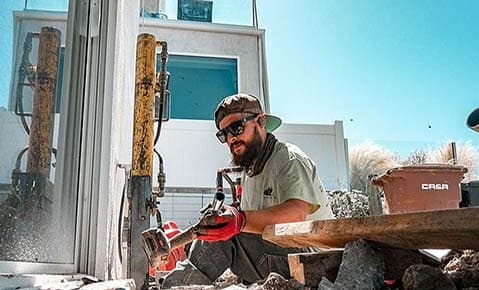
It’s crazy to think that there is a foam that can stabilize a building and is capable of lifting a home or business… quite literally. Polyurethane foam has been used in the foundation repair industry for a few decades, being able to densify soil and stabilize buildings (alongside other repair methods) that deal with foundation settlement.
But can Polyurethane foam be used to stabilize a building on its own? Well, that depends on the circumstances.
We understand how this stuff works and when it’s most appropriate to apply it.
What Is Polyurethane Foam?
Polyurethane sounds like a complex chemical that would turn people into zombies. Or an off-brand version of propane. Either way, it’s not as scary of a substance as people think.
Polyurethane is a combination of compounds composed of polyol and diisocyanate, a resin and isocyanate.
You’ll see polyurethane foam used for deep injection for applications such as soil densification, void fill, and releveling.
Polyurethane has a deep history and multitudes of applications, even though it’s relatively new in the foundation repair industry.
Polyurethane Foam Is Safe for the Environment
Again, this stuff won’t contaminate the soil or kill the plants in your garden. Polyurethane is used in areas like shoes, mattresses, insolation, and even pacemakers, which go in your body. The scary word isn’t actually an intimidating thing.
If you’re still not convinced, read our article on why you don’t need to worry about polyurethane foam being dangerous.
Polyurethane Foam Applications
Void Fill and Structural Support
This one is pretty straightforward. If there are voids or micro voids in the soil, they will be filled to stabilize your slab-on-grade foundation home or business, especially after foundation leveling.
The soil will be densified under a structure to offer additional support on top of a push pier and helical pier underpinning system.
Releveling
It’s hard to believe foam can lift a building, huh? Yeah, it’s both nuts and possible. Polyurethane foam expands in all directions when the expansion process happens.
Many injection tubes are put into the ground that injection guns are attached to. The Polyurethane foam will be injected and will gradually raise a building a little bit.
Don’t expect this stuff to lift 16 inches. That’s a whole bunch of polyurethane your would need.
Funny enough, there have been situations where Polyurethane foam was better suited to lift compared to the pier systems. It doesn’t happen often, but there have been those occasions.
When the foam has nowhere to go, it expands and gets a better lift.
Polyurethane can also relevel concrete. That way you don’t have to remove or replace settling concrete.
Can Polyurethane Foam Stabilize My Home or Business Without Push Pier or Helical Pier Underpinnings?
Yes, but it ultimately depends on the circumstances of the foundation issue you’re dealing with. Don’t expect Polyurethane foam for your particular situation to be the recommended solution.
For instance, some soils don’t permeate and mix as well with polyurethane. Sandy soil is excellent for polyurethane foam to permeate through. Clay soil is a little bit different story. The clay soil will be pushed in all directions while the polyurethane turns into a giant blob.
Polyurethane in clay soil can support a building on its own if it’s done correctly. Putting them in increments and stacking them on top of each other until it reaches the foundation can work. The issue is that quite a lot of chemicals would be used to create the polyurethane foam.
You don’t want to dump foam into the ground if the solution isn’t optimal for your situation. Even if it can work, other options might be more practical and cost-effective.
It Depends on What You Want to Do for Your Foundation Repair
A while back, our team worked with a homeowner who wanted to use polyurethane foam to raise a home that had settled three inches.
His neighbors had their water runoff go to their property line, which inevitably causes soil to erode. It just so happens his home was right where it was sinking.
So even if everything was lifted with Polyurethane foam, the water can continue to do damage to the soil around it. There’s nothing to worry about with the foam since it’s water resistant, but the damaged soil could ultimately cause a home to sink again.
In that particular case, the better fit was galvanized steel push pier or helical pier underpinning, which carries the home below the soil the water was eroding.
When these piers make it to loadbearing strata or bedrock, the soil can move all it wants since the load is transferred to an in-bearing system. Think of this underpinning system as acting like stilts. Remove five feet of soil from under the home and the piers should still hold everything up as though nothing happened.
Stabilizing using only polyurethane foam might not be your optimal solution to your foundation issues, especially if your home or business is on a hillside. You’ll want a solution that carries the load below the soil that is moving.
You Want Your Job Done Right the First Time
The whole point of foundation repair is to ensure your home or business will no longer be affected by foundation issues. It depends on the circumstances.
We want your foundation repair to address the cause the first time. A temporary fix can mean paying for the same repair twice.
Get Advice From a Professional Who Looks for the Cause
You’ve learned about polyurethane foam, its applications, if it can stabilize your home or business without piers, and what you need to consider for your foundation repair. You want to make sure your foundation repair addresses the cause the first time. Using only Polyurethane foam on its own might only help you temporarily.
Dalinghaus Foundation Repair has completed more than 2,000 foundation projects since 2011, and polyurethane foam is only one of the solutions we use. We want to find the best solution to fit your needs.
Learn more about other foundation repair solutions such as crawlspace foundation repair, and the applications of Polyurethane foam
If you live in Southern California, Arizona, or Nevada, book a free 60-90 minute foundation evaluation to see which repair is best for you.
Schedule a Free Evaluation
Foundation movement is easier to judge in person than from a photo. Schedule a free evaluation and a Dalinghaus specialist will walk the property with you and explain what the evidence shows.