How to Fix a Sinking Foundation: Underpinning
The ugly truth is that in a world full of expansive soil, fill soil , and gravity foundations sink. Schedule a free evaluation with Dalinghaus.
The ugly truth is that in a world full of expansive soil, fill soil , and gravity foundations sink. In the foundation repair business, we refer to this sinking as foundation settlement.
Foundation settlement is always due to incompetent, non load-bearing soil. This forces the home to either sink or swim. When the house sinks, this causes undue pressure and stress on your home’s foundation, resulting in a myriad of signs and symptoms.
All we ask in return is your email. Sounds like a good trade to me.
A sinking foundation is a problem for a variety of reasons, but the biggest issue is it hits you where you hurt most: your pocketbook. Nothing quite sinks your home equity like a fouled-up foundation.
This is such a major issue we have two whole articles dedicated to it:
So, the question remains, how do you throw a lifejacket on your home’s sinking foundation? The answer: underpinning.
Read more: Is my foundation sinking?
What Is Underpinning?
Underpinning is the strengthening and reinforcing of an existing foundation, typically by extending the depth and breadth of the foundation.
Questions we’ve received on the topic of underpinning include:
- What exactly is underpinning?
- What is underpinning a house foundation?
- Is underpinning beneficial?
- When should you think about underpinning services?
Well, since you asked, we’ve answered. In this article, we are going to cover 5 main types of underpinning:
- Mudjacking/Slabjacking
- Caisson and Girder Beam
- Push Pier Systems
- Helical Pier Systems
- Polyurethane Foam
So, let’s pin the tail on this donkey.
Read more: Underpinning VS Foundation Repair
Mudjacking and Slabjacking Underpinning
Mudjacking is a form of underpinning that has been around since the 1950s and is now considered by many foundation repair professionals an antiquated form of foundation repair.
Mudjacking is the lifting or leveling of a foundation, driveway, or slab by pumping a mixture of slurry ( cement, sand, and soil) into application holes, the incredibly high delivery pressure raising the sunken slab.
Mudjacking follows the drill, pump, patch application model.
It is referred to as mudjacking because mud is a synonym for cement, which is funny because if we trace mudjacking back to its Greek roots, it’s a synonym for ” bad idea.”
The problems with this form of underpinning are endless
- The application is messy and invasive, with application holes being 2-3 inches in diameter. These holes do not add any aesthetic value to your slab and can compromise its structural integrity.
- You’re adding weight to a sinking ship. Adding more weight to an already sinking foundation proves ultimately unhelpful, what we call in the business, counterproductive.
While mudjacking can fix your sinking foundation, it’s not the best option.
On the official Dalinghaus Underpinning Effectivity Scale, we give mudjacking a 2 out of 10. It’s messy. It’s often a temporary fix. It’s old-school. We’ve evolved, we no longer need to play in the mud.
Caisson and Girder Beam Underpinning
Caisson and Girder Beam underpinning is like a blunt force trauma instrument. There’s no sophistication. We’ve all seen caissons, huge concrete pillars that hold up bridges and freeways.
Now, imagine burying 2 or 3 caissons underneath your current home’s foundation. Yes, it’s as chaotic and cumbersome as you envision. The home becomes a construction zone.
We’re talking orange cones, a crane, massive holes ripped through your foundation, and a dug-up home looking like WWI trenches.
The home is dug up for the grade beam application. A grade beam is an addition to a building’s foundation that is a reinforced concrete beam that redirects the load from a bearing wall, dispersing the load between caissons.
This project can take anywhere from 1-5 months. That’s a helluva of a long time to spend with your in-laws or holed up in some cheap motel.
This problems with this form of underpinning are:
- Caissons simply add more weight unless they reach bedrock.
To learn more about caisson and girder beam repair, check out our article : Why Grade Beams & Caissons Don’t Work Well for Foundation Repair.
While caisson and girder beam underpinning could potentially fix your sinking foundation (if it hit bedrock) it is far from the optimal solution.
On the official Dalinghaus Underpinning Effectivity Scale, we give Caisson and Girder Beam underpinning a 3 out of 10. It turns your home into a construction zone. It only works if bedrock is accessible. It’s so damn expensive, you might as well get a Fine Arts Degree.
Push Pier Underpinning
Push Pier underpinning is a relatively new technology that utilizes steel interlocking pipes that are hydraulically driven into competent, load-bearing soil and anchored to a home’s foundation via a remedial bracket.
They act as underground stilts, keeping your home steady. Push Piers prove a viable, practical, affordable option to securing your sinking foundation.
Push piers secure, stabilize, and/or assist in lifting the home back to maximum practical recovery. Push piers have a relatively simple application process.
- Comprised of galvanized steel to impede rust/oxidization
- Driven until the hydraulic gauge proves the pier can carry its share of the load, rather than to a published capacity figure
- In sizes ranging from 2-7/8”, 3.5” and 4.5” (and are measured by the diameter of the pipe)
- Generally pushed down to a depth of 25 to 30 feet
- Comprised of three main components: Remedial Bracket, Starter, & Extensions.
Push piers steel systems are far less invasive than mudjacking and caisson & girder beam underpinning. The entire project usually only takes a week, 2 at most.
The one downside to push piers is that because push pier installation relies on the weight of your house for installation, it is not always conducive to single-story homes.
On the official Dalinghaus Underpinning Effectivity Scale, we give push pier underpinning a 9 out of 10.
Helical Pier Underpinning
Helical pier underpinning is also a newer, more streamlined form of underpinning. They are definitely a Grade-A option in securing your sinking foundation.
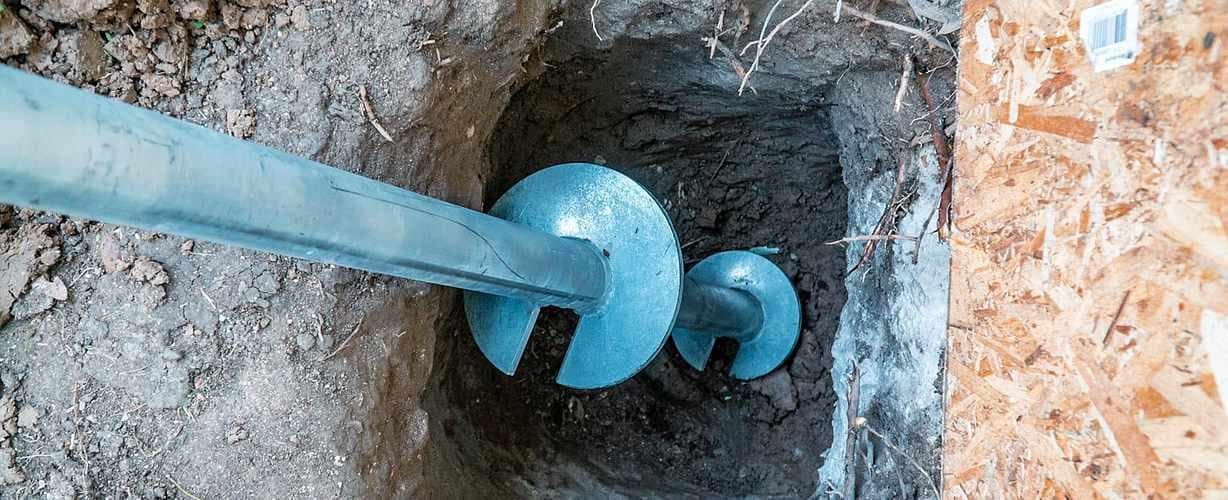
Helical pier underpinning utilizes steel circular or square pipes that are hydraulicly screwed down to competent, load-bearing soil. They are attached to the foundation via a remedial bracket and help secure, stabilize, and/or lift a structure.
Helical piers also act as underground stilts, anchoring your home into competent, loadbearing soil. The entire project only takes 1 to 2 weeks.
- Comprised of galvanized steel to impede rust or oxidization
- Come in sizes ranging from 3′, 5′, 7’, 10′ or 20′
- Comprised of a lead, extensions, & remedial bracket
- Generally pushed down to depths of 25 to 30 feet
On the official Dalinghaus Underpinning Effectivity Scale, we rate helical pier underpinning a 9.5 out of 10.
Polyurethane Underpinning
Polyurethane underpinning is similar to mudjacking in the drill, pump, patch application model, but proves far less invasive. The application site is only 5/8ths inch.
Here at Dalinghaus, we often use polyurethane in conjunction with push pier and helical pier systems to void fill after a lift. However, in some instances, polyurethane foam can underpin solo.
Polyurethane foam is an injectable polyol and isocyanate resin sealant, insulation, grout which expands upon application providing void fill, structural support, and re-leveling properties.
Polyurethane is, in short, a gift from heaven and sure to address your sinking house. We love polyurethane so much; we have 3 whole articles about it
- 5 Steps to Polyurethane Foam Injection (From Drill Holes to Cure)
- Polyurethane Injection VS Mudjacking (weight, application, and cure time)
- How Much Does Polyurethane Cost (From Void Fill to Deep Injection)
On the official Dalinghaus Underpinning Effectivity Scale, we rate polyurethane underpinning a 10 out of 10. It can reach every nook and cranny. It’s typically a one-day operation.
Choose Dalinghaus to Underpin Your Foundation
Dalinghaus Foundation Repair can help you address a sinking foundation with helical pier, push pier, and polyurethane underpinning.
We do foundation underpinning the right way.
Schedule a Free Evaluation
Foundation movement is easier to judge in person than from a photo. Schedule a free evaluation and a Dalinghaus specialist will walk the property with you and explain what the evidence shows.