
No path for water to leave the lot
Without surface drains or working gutters and extensions, rainfall soaks straight down beside the foundation, loading the soil with water that then migrates under the home.

Groundwater seepage soaks a crawl space from below, no rain required on the day you find it. Here is why it happens and how drainage ends it.

A local specialist will evaluate your foundation, walk you through the findings, and send a clear estimate. No cost, no pressure.
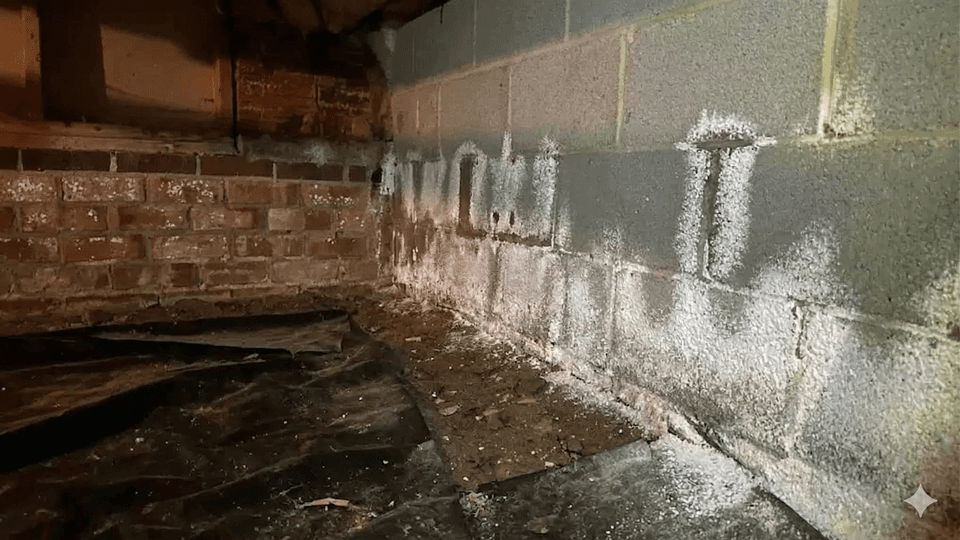
Groundwater seepage is water arriving from the soil itself rather than from a leak or a storm you can point to. After wet weather, the ground around and beneath your home holds water, and that water moves toward any space with less pressure, which includes your crawl space. It rises through the soil floor, wicks up into concrete piers and stem walls, and pushes through cracks and cold joints in the foundation perimeter. The result is a crawl space that stays wet long after the rain stops: darkened damp soil, water staining low on the stem walls, white mineral deposits where moisture evaporated out of the concrete, and in heavier cases, water actually weeping through cracks. Seepage matters because it is patient. It keeps the soil under your supports soft, it keeps humidity high enough to rot posts and girders, and it feeds the swell half of the clay cycle that moves piers out of position. It also does not fix itself, because the source is the water table and the drainage pattern of your lot, and neither of those changes without help. The good news is that seepage responds very well to drainage done correctly on the surface, where it is far cheaper to manage water than under the house. Seepage cannot be caulked away, because the supply is the ground itself. The workable strategy is management: lower what reaches the house with exterior interception drains, keep roof water from recharging the soil beside the foundation with downspout runoff extensions, and give what still rises a controlled path out via under house drainage matting routed to an exit away from the house. How the layers fit together is covered on the waterproofing service page.
For the repair side of this, the crawl space repair solutions page lists every method Dalinghaus installs, including the ones that fix problems other than groundwater seepage.
Without surface drains or working gutters and extensions, rainfall soaks straight down beside the foundation, loading the soil with water that then migrates under the home.
When the ground slopes toward the house, every storm delivers water to the foundation line, and the crawl space stays saturated far longer than the rest of the yard.
In wet years and low-lying areas, the water table rises close enough to the surface to keep the crawl space soil wet from below for months at a time.
Saturated soil presses water against the foundation perimeter, and small cracks give it an easy way through. The seepage then widens its own path over time.
Solving groundwater seepage means addressing the underlying soil, pressure, or settlement cause. Not just patching the visible damage. Below are the engineered solutions we install most often for this symptom in California, Arizona, and Nevada homes.
If your home is showing groundwater seepage, the team you call matters. Dalinghaus crews handle crawl space repair and related structural work across California, Arizona, and Nevada, and nothing else.
Foundation repair, concrete leveling, and crawl space repair are our entire focus. Not a sideline.
More than 2,000 projects on the clay and desert soils of California, Arizona, and Nevada since 2011.
CSLB License #983851 in California, ROC #330307 in Arizona, and License #0089738 in Nevada. Look us up with the state before we ever set foot on your property.
Warranty terms come in writing with every proposal, and the terms that apply to your job are stated in that job's paperwork. Ask your project specialist during the free evaluation.


Don't see your question here? Our team is happy to help. Reach out anytime.
A leak has a fixture behind it and flooding has a storm behind it, but seepage has the soil behind it. Water held in saturated ground moves slowly through and under the foundation, so it can appear days after rain or with no rain at all. That is also why patching a damp spot never works: the supply is the surrounding soil, and the fix is drainage.
How a repair moves from free evaluation to completed work once groundwater seepage is diagnosed.
A local specialist walks the areas showing groundwater seepage, measures what is moving, and answers your questions on site. No cost, no obligation.
The method is matched to the cause behind the groundwater seepage, with scope and pricing in writing. No pressure in either direction.
A Dalinghaus crew corrects the movement behind the groundwater seepage, and leaves the site cleaner than we found it.
Before you call anyone about groundwater seepage, read how homeowners across California and Arizona rate our work.
Share a few details and a local specialist will follow up as soon as possible to set your evaluation.
A free evaluation pins down the cause: one visit, clear findings, written estimate.