
Saltwater exposure
Salt attacks concrete chemically and corrodes any steel it reaches, the ongoing cost of every seawall repair project on this coast. It never stops collecting.
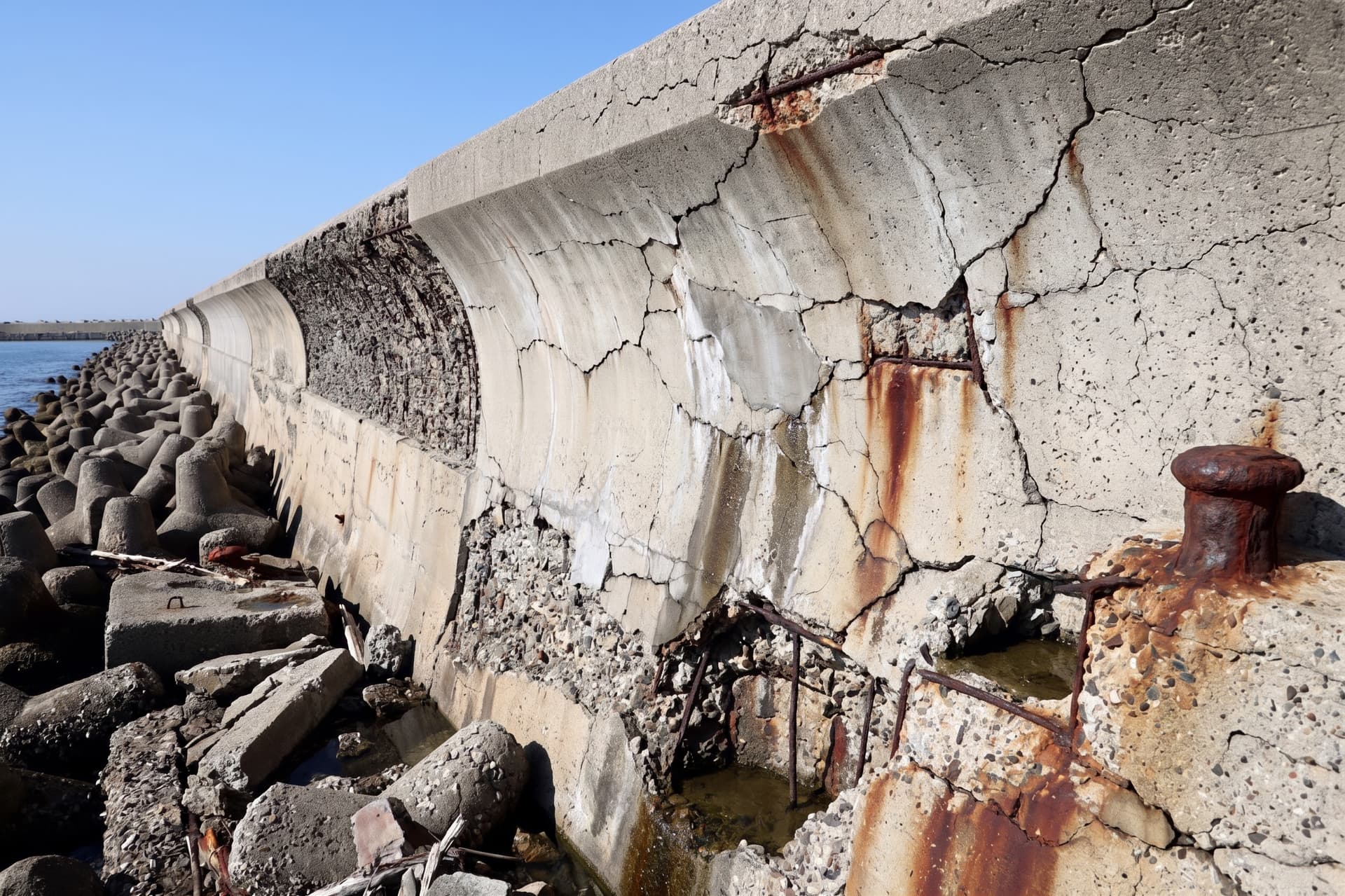
Spalling, rust staining, and crumbling material are your seawall aging faster than it should. Here is what drives deterioration and when to intervene.

A local specialist will evaluate your foundation, walk you through the findings, and send a clear estimate. No cost, no pressure.
Deterioration is the slowest seawall problem and the easiest to rationalize away, because it looks like ordinary aging. On concrete walls it shows up as spalling, the surface flaking and popping off in patches, often with exposed aggregate or, worse, exposed reinforcing steel. Rust stains bleeding through the face mean saltwater has already reached the steel inside, and rusting steel expands with enough force to split concrete from within. On walls with wood elements, look for soft, crumbling, or discolored wood at and below the waterline. The mechanism is the marine environment itself: salt attacks the material, tidal cycling soaks and dries the wall twice a day, and wave action works at every weakness it opens. Deterioration matters because it compounds. A wall losing surface material has less cover protecting its steel, corroding steel opens more cracks, and every new opening gives water another path to the soil behind the wall. The difference between a wall that needs surface restoration and one that needs structural repair is mostly a question of when someone acted. An evaluation tells you where on that timeline your wall stands. Deterioration is a process, not a verdict, and interrupting it early keeps the wall you have. Voids and weakened soil behind aging walls are stabilized with expanding marine polyurethane, walls losing their grip on the soil get re anchored into competent ground, and a failing crown is addressed by replacing the cap before water keeps entering from above. The right combination comes out of a documented evaluation of what, exactly, is deteriorating.
For the repair side of this, the seawall repair solutions page lists every method Dalinghaus installs, including the ones that fix problems other than deterioration.
Salt attacks concrete chemically and corrodes any steel it reaches, the ongoing cost of every seawall repair project on this coast. It never stops collecting.
The tide soaks the wall and dries it twice a day, driving salt deeper into the material with every cycle and stressing the surface until it spalls.
Once salt reaches the steel inside a concrete wall, the rust expands and splits the concrete around it, the same process that fails buried anchor rods over time.
Every seawall material has a service life in constant water contact, which is why watching for seawall warning signs matters more as a wall ages. Original construction quality, concrete mix, and decades of load all set how fast a wall weathers.
Solving deterioration means addressing the underlying soil, pressure, or settlement cause. Not just patching the visible damage. Below are the engineered solutions we install most often for this symptom in coastal California homes.
If your home is showing deterioration, the team you call matters. Dalinghaus crews handle seawall repair and related structural work across coastal California, and nothing else.
Foundation repair, concrete leveling, and crawl space repair are our entire focus. Not a sideline.
More than 2,000 projects on the clay and desert soils of California, Arizona, and Nevada since 2011.
CSLB License #983851 in California, ROC #330307 in Arizona, and License #0089738 in Nevada. Look us up with the state before we ever set foot on your property.
Warranty terms come in writing with every proposal, and the terms that apply to your job are stated in that job's paperwork. Ask your project specialist during the free evaluation.


Don't see your question here? Our team is happy to help. Reach out anytime.
Weathering is normal; structural deterioration is not. A wall can look aged and still be sound. The line is crossed when the surface starts spalling off, rust bleeds through the face, or material at the waterline goes soft. Those signs mean the wall is losing capacity, and they compound if left alone.
How a repair moves from free evaluation to completed work once deterioration is diagnosed.
A local specialist walks the areas showing deterioration, measures what is moving, and answers your questions on site. No cost, no obligation.
The method is matched to the cause behind the deterioration, with scope and pricing in writing. No pressure in either direction.
A Dalinghaus crew corrects the movement behind the deterioration, and leaves the site cleaner than we found it.
Before you call anyone about deterioration, read how homeowners across coastal California rate our work.
Share a few details and a local specialist will follow up as soon as possible to set your evaluation.
A free evaluation pins down the cause: one visit, clear findings, written estimate.