
A void under one side of the joint
Water washed the base out, clay shrank away from it, or fill compressed, and the section above dropped into the gap. An offset between two slabs is a void reporting itself at the surface.
Offsets between concrete sections are the most reliable tripping hazards on a property, and they grow, because the section that dropped is still moving.

A local specialist will evaluate your foundation, walk you through the findings, and send a clear estimate. No cost, no pressure.
A tripping hazard in concrete is almost never a pothole and almost always an edge. Two sections that were poured flush are no longer flush, and the vertical step between them catches a toe that was not being lifted very high, because people walking a familiar path stop looking at it after the first few trips. The numbers involved are smaller than most people expect. A vertical change of roughly a quarter of an inch is enough to catch a shoe. Half an inch is enough to be seen and stepped around by somebody who is paying attention, which is not everybody, and not at night. The places they appear are predictable: where a driveway meets a garage floor, where walkway panels meet each other, at the top riser of a set of entry steps, along a pool coping, and at any joint between a slab and the structure it was poured against. What they share is a cause. One side is sitting on soil that gave way and the other is not, so the offset is the visible half of a void, and the void is still there. That matters for the repair, because the section that dropped has not finished dropping, and an offset that is a nuisance in one season is a liability in the next. On a public frontage or a commercial approach, the property owner generally carries that risk, which is why offsets belong on a written report as measurements rather than as impressions.
For the repair side of this, the concrete leveling solutions page lists every method Dalinghaus installs, including the ones that fix problems other than tripping hazards.
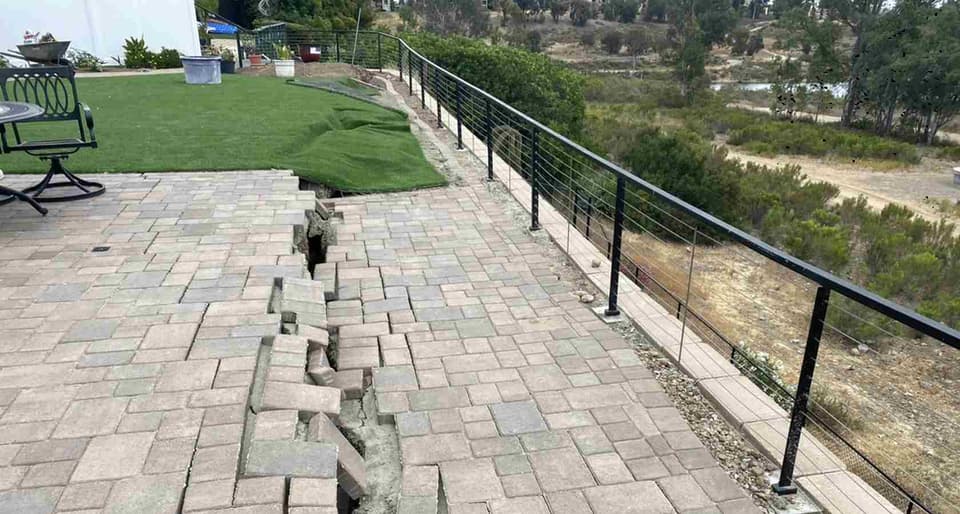
Water washed the base out, clay shrank away from it, or fill compressed, and the section above dropped into the gap. An offset between two slabs is a void reporting itself at the surface.
Roots grow toward the damp soil under concrete and raise whatever sits above them, so one panel goes up while its neighbor stays put. The same tree can produce raised panels and sunken ones a few feet apart.
A driveway and a garage floor, or a walkway and a porch, sit on different ground and settle at different rates. The joint between them is a hinge, and the step is where the difference shows.
Patching material laid proud of the surface, or a section replaced slightly high, leaves a permanent edge. This one is not settlement at all, and grinding the ridge flush is usually the whole answer.
In the higher elevation parts of our footprint, a section can rise seasonally and settle back, which produces an offset that comes and goes. A survey taken twice tells you which kind you have.
Solving tripping hazards means addressing the underlying soil, pressure, or settlement cause. Not just patching the visible damage. Below are the engineered solutions we install most often for this symptom in California, Arizona, and Nevada homes.
If your home is showing tripping hazards, the team you call matters. Dalinghaus crews handle concrete leveling and related structural work across California, Arizona, and Nevada, and nothing else.
Foundation repair, concrete leveling, and crawl space repair are our entire focus. Not a sideline.
More than 2,000 projects on the clay and desert soils of California, Arizona, and Nevada since 2011.
CSLB License #983851 in California, ROC #330307 in Arizona, and License #0089738 in Nevada. Look us up with the state before we ever set foot on your property.
Warranty terms come in writing with every proposal, and the terms that apply to your job are stated in that job's paperwork. Ask your project specialist during the free evaluation.


Don't see your question here? Our team is happy to help. Reach out anytime.
Smaller than people think. About a quarter of an inch is enough to catch the toe of a shoe on a familiar path, because a stride learns a surface and then stops checking it. Half an inch is visible enough that attentive people step around it, which leaves everyone who is carrying something, walking at night, or not from here. Where the concrete is a public frontage or a commercial approach, the property owner generally carries that liability, so the measurement belongs on paper.
How a repair moves from free evaluation to completed work once tripping hazards is diagnosed.
A local specialist walks the areas showing tripping hazards, measures what is moving, and answers your questions on site. No cost, no obligation.
The method is matched to the cause behind the tripping hazards, with scope and pricing in writing. No pressure in either direction.
A Dalinghaus crew corrects the movement behind the tripping hazards, and leaves the site cleaner than we found it.
Before you call anyone about tripping hazards, read how homeowners across California and Arizona rate our work.
Share a few details and a local specialist will follow up as soon as possible to set your evaluation.
A free evaluation pins down the cause: one visit, clear findings, written estimate.