
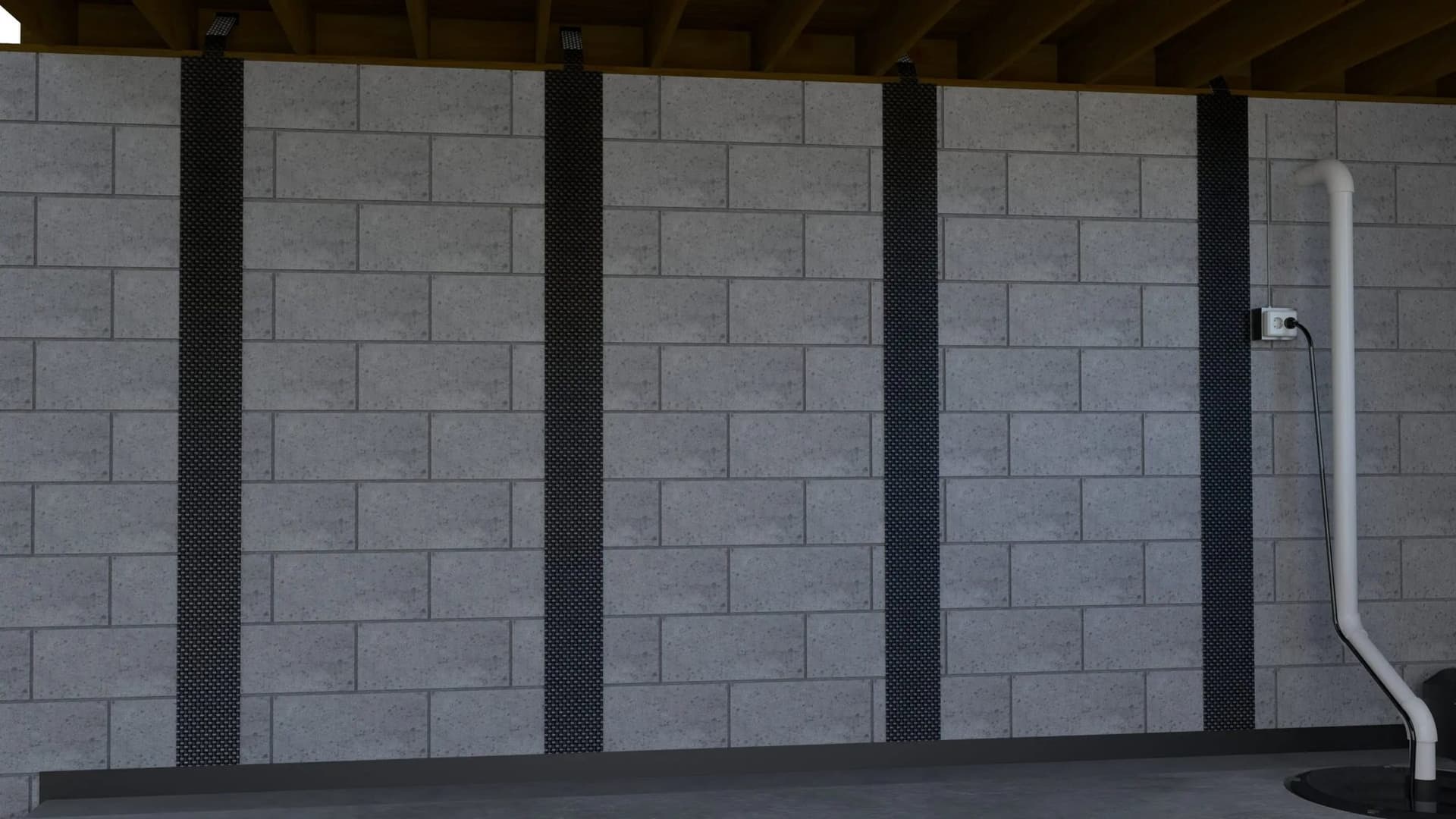
Stronger than steel by weight, thinner than the paint that covers it.
Carbon fiber installation bonds straps to a cracked or bowing retaining wall. They refuse to stretch, so the crack stops spreading and the wall face stays together under load.

Let's take the first step toward solid ground.
A local specialist will evaluate your foundation, walk you through the findings, and send a clear estimate. No cost, no pressure.
What to know about carbon fiber installation, and when it's the right call.
Concrete and masonry are strong when squeezed and weak when stretched, and a retaining wall under soil pressure gets stretched: the face bends, tension builds on the outside of the bend, and the wall cracks along it. Carbon fiber attacks that exact weakness. Each strap is a band of woven carbon filaments with enormous tensile strength for its weight, bonded to the wall with structural epoxy that transfers load between wall and fabric. Once cured, the strap carries the tension the masonry cannot, so a crack cannot widen and a bowing section cannot keep bending without defeating a material engineered not to give. Placement follows the stress: straps run across cracks and vertically along bowing faces, and wraps wrap corners where pressure concentrates. The bond is the craft. The surface is ground clean, the epoxy is worked into the wall, and the fiber is saturated so it acts as one piece with the structure. The result adds strength without adding weight, bulk, or any change to how the wall drains. Carbon fiber is the face strengthening half of a larger toolkit: when the whole wall is rotating, anchor reinforcement carries the load carbon fiber cannot, the cracks themselves are sealed through our crack repair service, and a measured inspection decides which combination your wall actually needs.
The symptoms that usually lead to carbon fiber installation are on the retaining wall repair problem signs page, alongside the other signs that point to the same underlying cause.
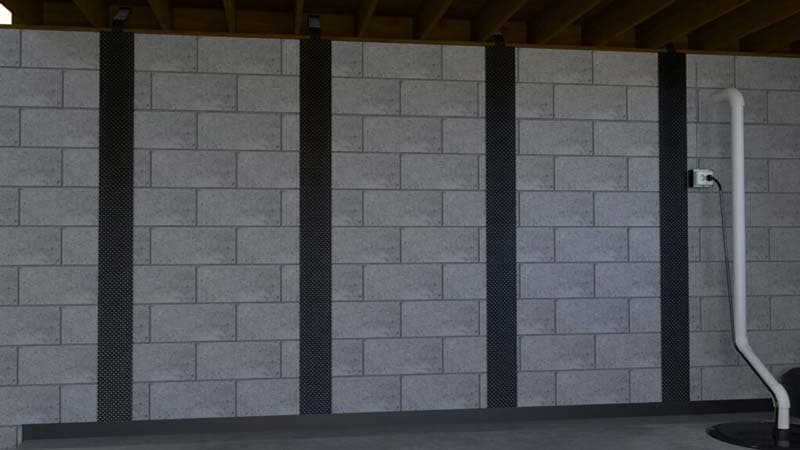
How we install carbon fiber installation.
Free evaluation
A specialist measures the wall's movement, maps the crack pattern, and confirms carbon fiber is the right tool, alone or alongside anchors and drainage work. You get the findings in writing.
Surface preparation
The wall face is ground and cleaned at each strap location, because the reinforcement is only as strong as the bond beneath it.
Bond the fiber
Structural epoxy is applied, and carbon fiber straps or wraps are set across cracks, along bowing sections, and around corners, then saturated so wall and fabric cure as one.
Cure and verify
The epoxy cures, the installation is checked against the plan, and the finished straps sit nearly flush, ready to paint if you want them invisible.
Stronger than steel, flat as paint.
Carbon fiber straps bond to the inside face of a bowing wall and refuse to stretch. Anchored top and bottom, they resist further inward movement of the wall, with almost zero loss of space.
Carbon Fiber Installation on a real project.
Carbon fiber installation bonds straps to a cracked or bowing retaining wall. They refuse to stretch, so the crack stops spreading and the wall face stays together under load.

Care and expertise from a team that's been doing this since 2011.
When the fix is carbon fiber installation, the installer matters as much as the method. Dalinghaus crews handle foundation, concrete, and crawl space work across California, Arizona, and Nevada, and nothing else.
Foundation repair, concrete leveling, and crawl space repair are our entire focus. Not a sideline.
More than 2,000 projects on the clay and desert soils of California, Arizona, and Nevada since 2011.
CSLB License #983851 in California, ROC #330307 in Arizona, and License #0089738 in Nevada. Look us up with the state before we ever set foot on your property.
Warranty terms come in writing with every proposal, and the terms that apply to your job are stated in that job's paperwork. Ask your project specialist during the free evaluation.
Answers to common questions about Carbon Fiber Installation.
Don't see your question here? Our team is happy to help. Reach out anytime.
No. Carbon fiber holds a wall in its current position and stops cracks from spreading, but it does not apply pulling force. When a wall needs to come back toward plumb, helical tiebacks or wall anchors do the pulling, and carbon fiber then keeps the wall face together. The two are teammates, not rivals.
Other retaining wall repair solutions we install.
Every solution is engineered for a specific soil profile and failure mode. Browse the full toolkit.
Anchor Reinforcement
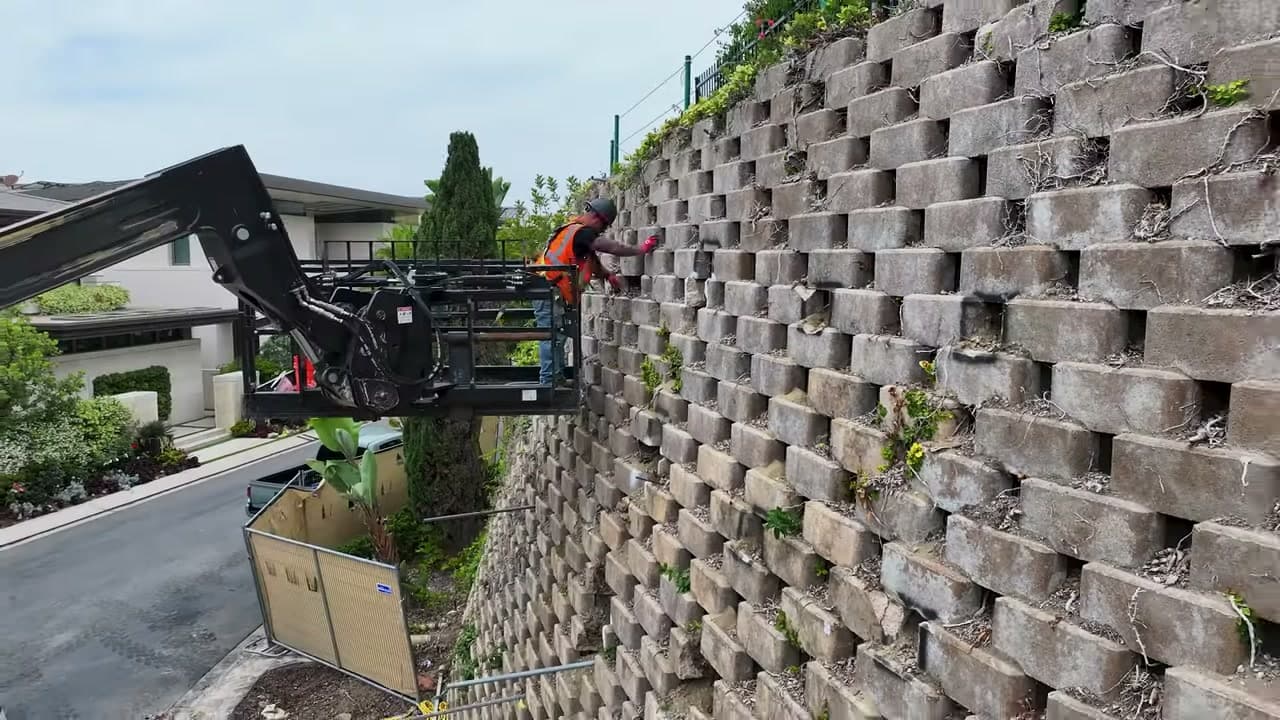
Anchor reinforcement, with helical tiebacks, wall anchors, and soil nails, reaches past the failing backfill into ground that does not move, then pulls the wall back toward plumb and keeps it there.
Learn more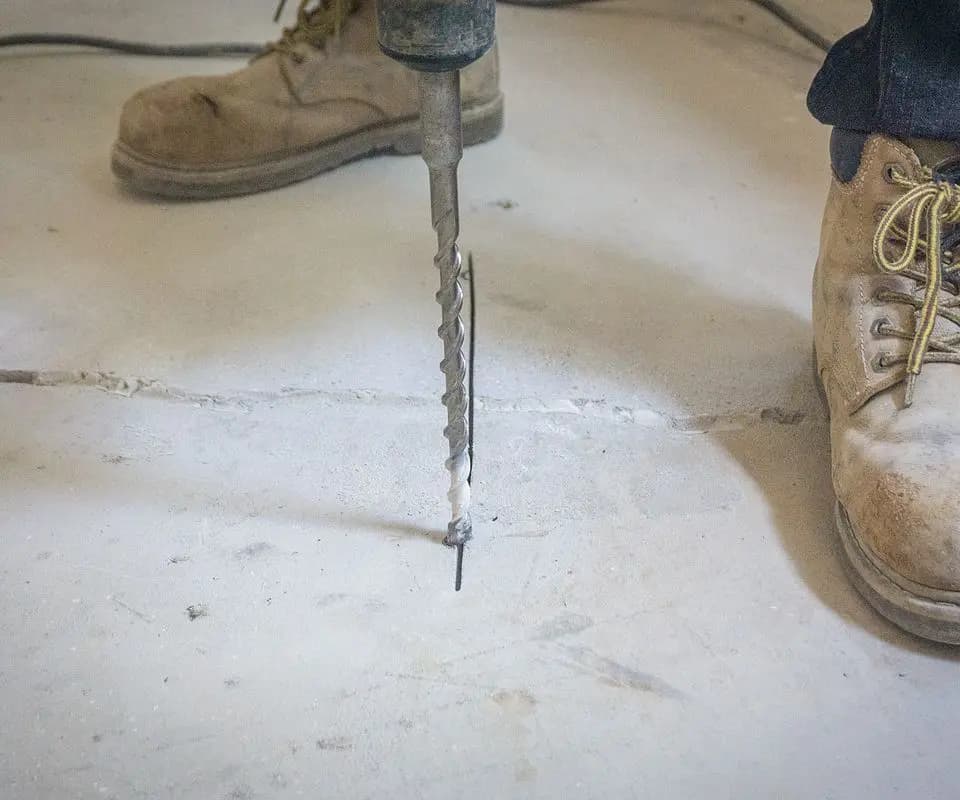
Polyurethane Injection
Polyurethane injection binds loose backfill, fills the voids water carved out, and closes the paths that let pressure build, all through holes smaller than a coin.
Learn more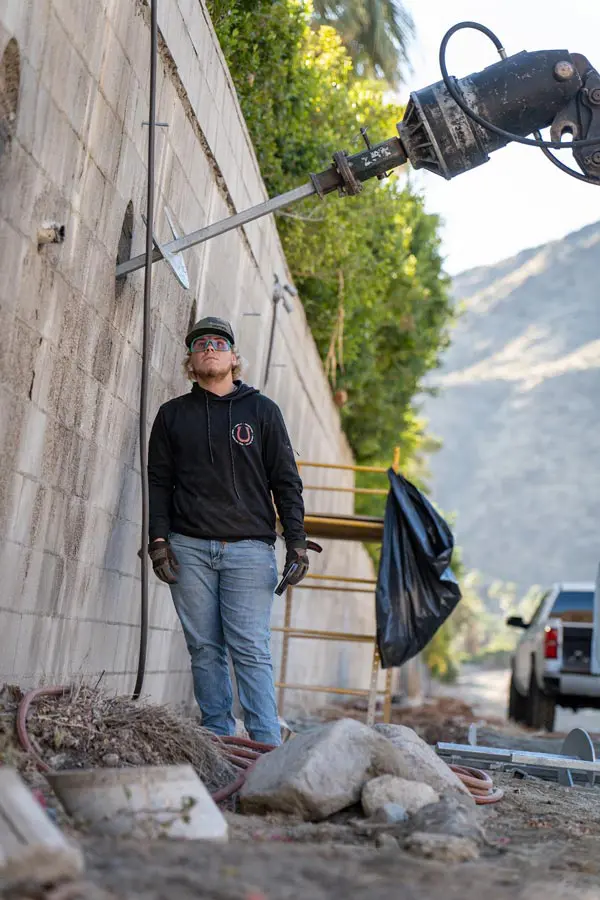
Retaining Wall Anchoring Systems
Anchoring systems tie a leaning retaining wall into stable ground beyond the soil that is pushing it, stopping the movement for a fraction of the cost and disruption of demolition.
Learn moreFrom free evaluation to installed carbon fiber installation.
How a carbon fiber installation project moves from diagnosis to completed installation.
Schedule your free evaluation.
A local specialist visits your home, evaluates the foundation, and answers your questions on site. No cost, no obligation.
Receive an estimate based on your needs.
We provide a clear, written estimate with a scope of work tailored to your home's specific issues.
Get your repairs.
Our crews complete the work on schedule, with the findings and scope in writing from the first visit.
More than 1,000 Google reviews across our offices, averaging 4.9 stars.
Before you choose who installs your carbon fiber installation, read how homeowners across California and Arizona rate our work.
Start with a free evaluation.
Share a few details and a local specialist will follow up as soon as possible to set your evaluation.
- A local foundation specialist on site
- A complete walk-through of the findings
- A clear written estimate at no cost
- No obligation, no pressure
Not sure which service you need?
A free evaluation covers all of it: one visit, clear findings, written estimate.