What Type of Foundation Do You Have?
Do you live in Southern California or Arizona and you're not quite sure what type of foundation your house has? Schedule a free evaluation with Dalinghaus.
Do you live in Southern California or Arizona and you’re not quite sure what type of foundation your house has? Maybe you recently moved in or perhaps you’ve lived in the home for years but you’re not a house builder and have never worried about the kind of foundation that supports your home. If you want to be able to determine what type of foundation your home has and the pros and cons associated with each, this article is for you.
Our team here at Dalinghaus Foundation Repair has completed more than 2,000 foundation projects since 2011 across Southern California and Arizona. We’re here to help you get to the bottom of foundation issues you may be facing, and that starts with understanding the kind of foundation you have!
This article covers the three main types of foundations used in the construction of homes and how a homeowner can spot the differences between those 3 kind of foundations.
The Types of Foundations Used by Builders in Home Construction
Throughout the country there are several main foundation types used in home construction. Slab foundations are one of the most common and seen in almost every state. Last but not least are crawl space foundations which come in several varieties resulting in a raised foundation.
Building codes and location of the home are going to be the two largest determining factors in the type of foundation your home was constructed with. Let’s dive into the specifics of each foundation type.
Slab Foundation (Slab on Grade)
Slab on grade foundations can be found in just about every state in the country, but they’re most prolific in areas that don’t experience ground freezing and thawing. These are one of the most simple foundations to understand in that the foundation is made up of a slab of concrete sitting directly on grade or dirt. This means there is no open air between the home’s flooring and soils beneath it.
It goes:
Most slab foundations are 4-8 inches thick with 18”-36” footings around the perimeter of the home. They can either be monolithic meaning poured all at once, or it can be several different sections… though monolithic slabs are much more common.
How to Spot a Slab Foundation
Now that we know a little bit more about slab foundations it’s time to discuss how a homeowner can spot a slab foundation.
The first thing you will want to do is determine if there is an area, or space, under the home’s flooring. This space would be what is typically considered a crawl space and is usually 18”-24” in height.
You can also walk around the perimeter of your home looking for ventilation holes or access points on the lower 18” of perimeter walls.
Home’s build with a slab foundation will also look like they’re sitting on level ground rather than being raised up off the ground.
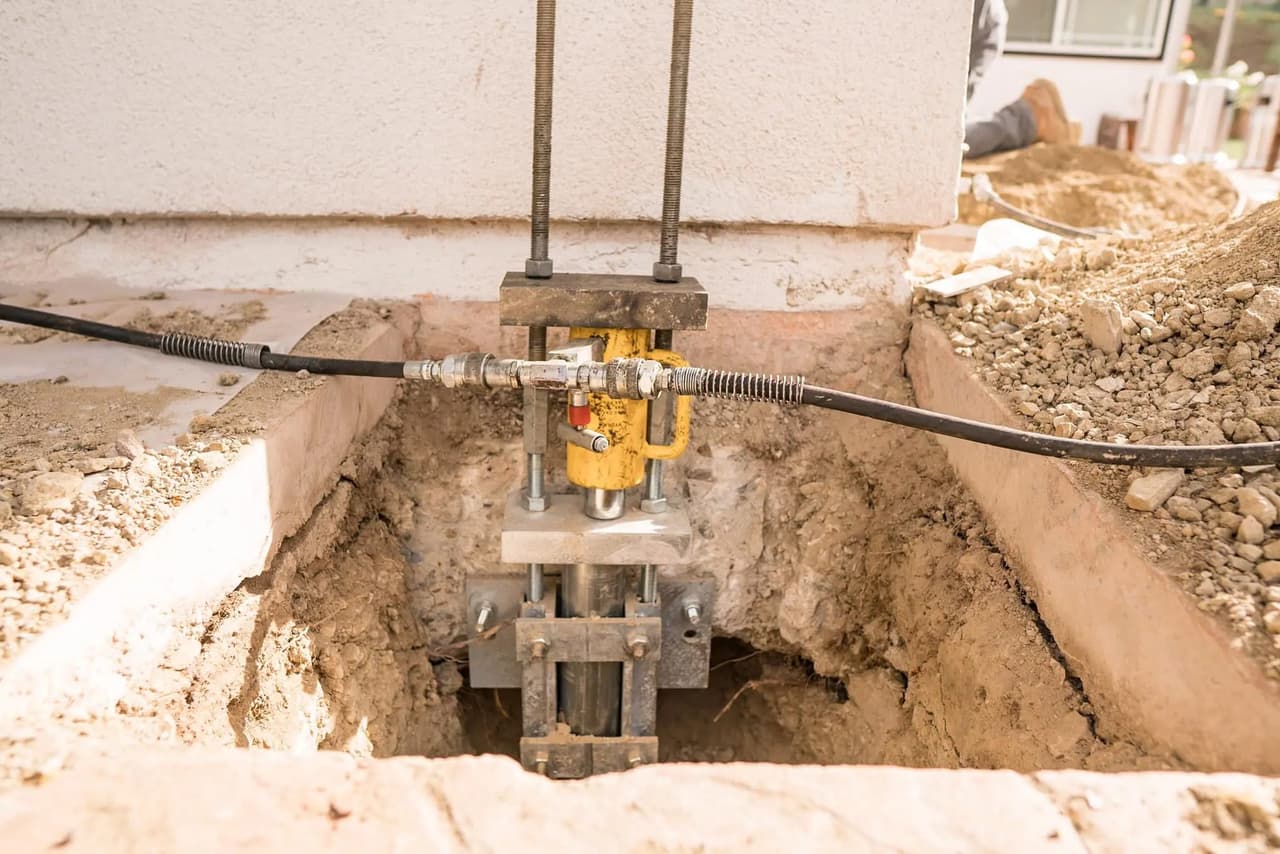
This is our team lifting a slab foundation that had settled several inches in Mission Viejo, CA.
Pros and Cons of a Slab Foundation
While slab-on-grade foundations are one of the most common they definitely have their pros and cons. As we mentioned before you’ll typically find slab foundations in areas that don’t experience ground freezing and thawing. This is due to the fact that continuous cycles of freeze/thaw leads to constant expansion and contraction of the surface soils. These cycles of freezing and thawing will inevitably lead to cracks from undue load stresses put on the slab. Let’s dive into more of the pros and cons:
Pros of a Slab Foundation
- Cost effective
- Impervious to bugs and termites
- Simple & Solid (usually)
Cons of a Slab Foundation
- Utilities ran through slab, require breaking out areas of foundation for repairs
- Little protection from flooding
- Lack of storage
Crawl Space Foundations
Crawl space foundations, or raised foundations, are the second most common type of foundation found in Southern California and Arizona.
These crawl space foundations utilize poured concrete footings to bear the load of the home along with posts and pads in a grid like manner to support the interior of the home and its flooring. We often see wooden posts with concrete pads, but that isn’t always the case.
How to Spot a Crawl Space Foundation
Now that we know what a crawl space foundation is let’s talk about how a homeowner can spot one!
One of the easiest ways to determine if a home has a crawl space to to walk the exterior perimeter of the home looking at the bottom 24 inches of the walls. You’ll be looking for vents, grates, or access points that someone could crawl through. It’s important to note that not all crawl space homes have exterior access points and they can sometimes be found on the floors of closets.
Want some better visuals of what a crawl space foundation looks like? Watch this video on YouTube of our team making repairs to a crawl space foundation that was well over 120 years old!
Pros of Crawl Space Foundations
- Extremely durable to floods and high ground water
- Provide better airflow under the home during summer months
- Access to utilities like plumbing, gas, and electrical
Cons of Crawl Space Foundations
- Can be difficult to crawl through and navigate
- Ventilates cold air during cooler months
- Wood materials susceptible to moisture and termites
Book a free evaluation
In this article, you learned about the 3 most common types of foundations found in the United States and how they’re constructed. You also learned how you, as a homeowner, can determine the type of foundation your home has.
Dalinghaus has been in the foundation repair industry since 2011 and has completed more than 2,000 foundation projects in that time.
If you live in Southern California or Arizona and would like to book a free evaluation, click on the blue Schedule Your Evaluation button below
Schedule a Free Evaluation
Foundation movement is easier to judge in person than from a photo. Schedule a free evaluation and a Dalinghaus specialist will walk the property with you and explain what the evidence shows.