Why is Your Wall Separating from Your Ceiling?
Is your wall separating from your ceiling? If so, you have likely wondered what the cause was and whether it was something that you should worry about.

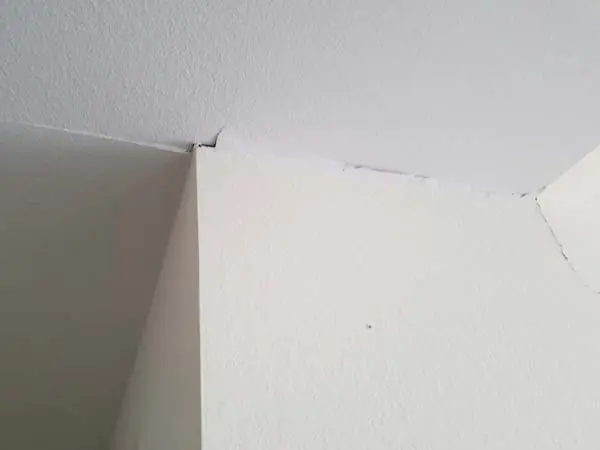
Is your wall separating from your ceiling? If so, you have likely wondered what the cause was and whether it was something that you should worry about. In this article, we’ll cover why a crack can form where a wall and ceiling meet. As you’ll soon see, some causes are more problematic than others.
Truss Uplift
A truss is nothing more than a timber beam that runs the entire width of your home to add structural support. Construction crews install trusses at the top level of your home as a less expensive alternative to traditional roof framing methods. However, some issues with trusses can arise, one of which is known as truss uplift.

Trusses typically lie between your top floor and your attic. Due to that arrangement, it is typical for the air above your truss to have a different temperature and humidity than the air below. This contrast in moisture and temperature can cause a truss to bow upward, especially during the winter months.
When a truss warps, the ceiling below it will bend as well. In many cases, this deformation can cause the ceiling to separate from the walls below it, resulting in a visible crack.
Structural Sagging
Separation between your ceilings and walls can also occur due to structural deficiencies in the ceiling itself. When joists within your ceiling fail beneath the weight they are meant to carry, the entire ceiling can begin to sag. As this sagging increases, cracks will likely form in the ceiling and at the point where your ceiling meets your walls.
Ceiling joists can begin to sag for several reasons. For instance, if the construction team that installed them failed to include enough joists or did not space them correctly, your ceiling will likely begin sagging.
Moisture can also present a problem for ceiling joists. As moisture accumulates, it can cause wood rot, which weakens your joists and may cause them to sag or break entirely.
Lastly, if you recently removed a load-bearing wall in your home, the ceiling that wall once supported will likely begin to fail. Removing load-bearing walls can also result in structural sagging that causes your walls and ceiling to separate from one another.
Differential Foundation Settlement
Foundation settlement is another common cause of a wall breaking apart from a ceiling. Foundation settlement occurs when the soil below your foundation shifts or sinks. Since your foundation depends on the soil for support, it will also move.
A small amount of uniform settlement is typical following construction. However, another form of settlement, differential settlement, results in significant uneven shifts that compromise the structural integrity of your entire home.
When differential settlement occurs, there may be several signs, including stuck doors, sloping floors, and foundation cracks. In addition to those signs, differential settlement can cause cracks between your walls and ceiling.
Drywall Problems
Our last cause of cracks where a wall and ceiling meet is the least concerning. At times, the reason why cracks in drywall form has nothing to do with an underlying structural issue. Instead, cracks can arise due to problems with your drywall.
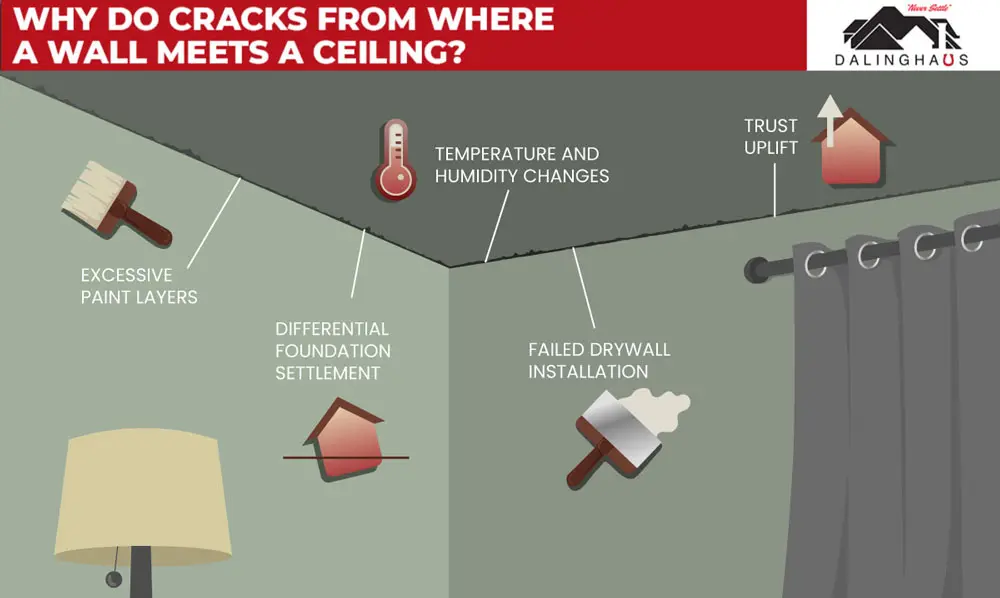
If you hire an inexperienced drywall contractor, there is a chance that they will fail to install your drywall correctly, which will quickly lead to cracks. Also, even if your drywall was installed correctly, changes in temperature and humidity can cause expansion and contraction that lead to cracks in your walls.
Drywall cracks do not necessarily imply a serious structural problem. However, most homeowners want to remove them as soon as possible simply because they are an eyesore.
What Should You Do When Cracks Form Between Your Wall and Ceiling?
Finding the right solution for walls that separate from your ceiling depends on the cause of the problem. However, no matter the cause, you’ll need to hire a professional to help you solve this issue. The three sections below will briefly explain some resolutions those professionals may provide.
Resolving Truss Uplift and Sagging Joists
If your wall and ceiling separations result from truss uplift or sagging joists needing framing repair, you’ll need to hire a contractor to evaluate the structures that make up your ceiling. Your contractor may deem it necessary to repair or replace certain ceiling portions.
In this instance, it is essential not to attempt to repair your ceiling alone. Attempting DIY repairs in these scenarios can make matters worse. As such, the safest and most effective way to address truss uplift or sagging joists is to rely on professional assistance.
Addressing Differential Settlement
Differential settlement is also an issue you cannot resolve alone. Instead, it will be necessary for you to find a foundation repair team in your area that you can trust to diagnose your differential settlement and find the most appropriate solution.

Often, the most common fix for differential settlement is to level your house using either push piers or helical piers. Both methods will make your home level again and add considerable strength and stability that will likely prevent future settlement.
Finding Drywall Repairs
As mentioned earlier, cracks arising from drywall problems are the least concerning and the easiest to repair. In most cases, all you’ll need to do is hire an experienced drywall technician to evaluate the drywall and patch any cracks that are present.
While it can be tempting to attempt DIY drywall repairs, it is always best to seek the help of a professional. Doing so ensures safety and that the job gets done right the first time. If your drywall cracks come from moisture, a dehumidifier can hold the humidity down for a while, but it cannot stop the water causing it. Tracing the source, usually a leak, roof water, or drainage that sends rain toward the house, is what keeps the cracks from returning.
Have a Pro Evaluate Your Wall and Ceiling Cracks
One of the most important themes of this article is the importance of finding professional help for any cracks that form between your walls and ceilings. If you live in Southern California, Nevada, or Arizona, Dalinghaus Foundation Repair should be your first choice for foundation inspections and repair services.
At Dalinghaus, we have extensive experience repairing crawl spaces, foundations, concrete, hillsides, and more. Reach out today for a free evaluation!
Schedule a Free Evaluation
Foundation movement is easier to judge in person than from a photo. Schedule a free evaluation and a Dalinghaus specialist will walk the property with you and explain what the evidence shows.
Written by
Brian Dalinghaus
Co-Founder, Dalinghaus Foundation Repair
Brian Dalinghaus founded Dalinghaus Foundation Repair with his brother Brad in Southern California in 2011. The brothers built the company on a Midwest work ethic and a single standard for every job: Never Settle.
More about Brian