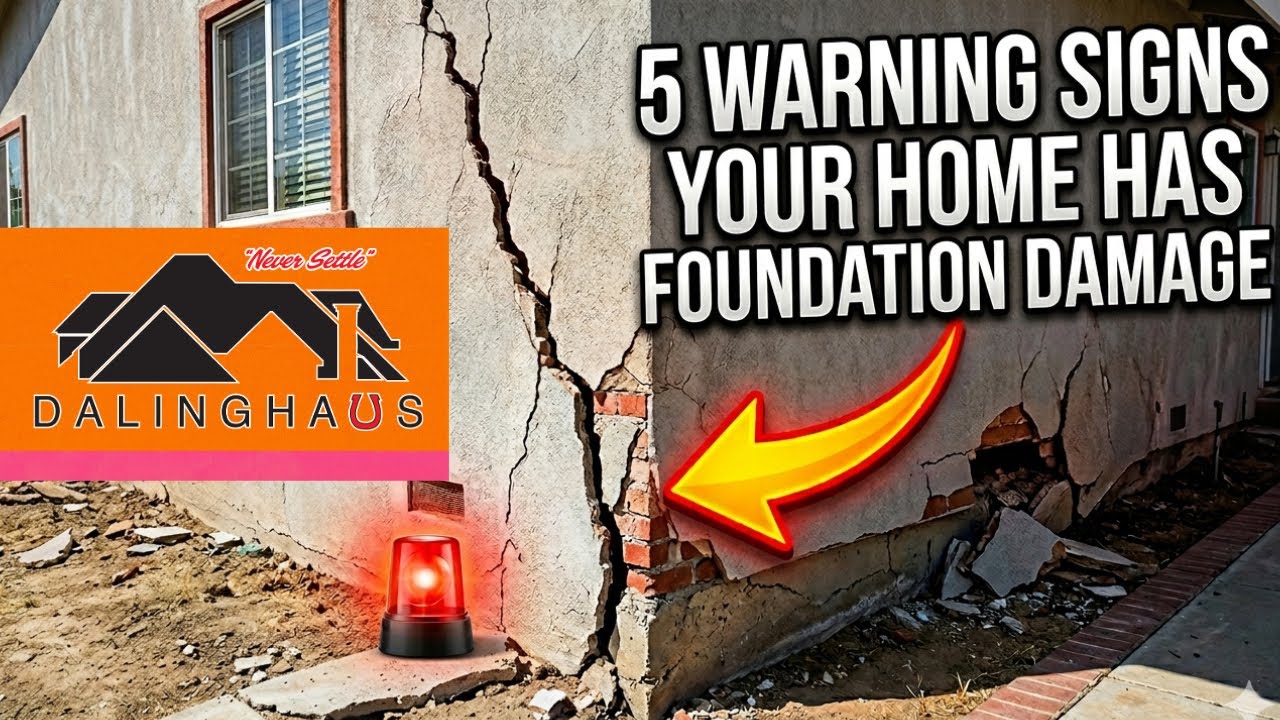

Differential settlement
One section of the foundation sinks while the adjacent section holds, putting the wall between them in shear. The wall tears diagonally from its weakest points, usually opening corners.
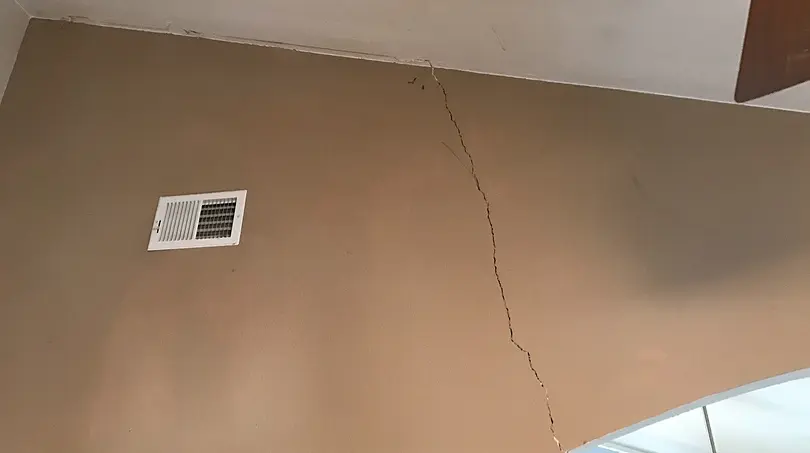
Angle is information. A diagonal crack means one part of the wall is moving relative to another, and that almost always starts at the foundation.

A local specialist will evaluate your foundation, walk you through the findings, and send a clear estimate. No cost, no pressure.
Crack direction is one of the most useful clues a house offers, and diagonal is the direction that points at the foundation. A wall that shrinks, from curing lumber or seasonal humidity, cracks vertically along seams. A wall that is being pushed sideways cracks horizontally. But a wall where one end is dropping relative to the other is in shear, and shear failures run at an angle, typically around forty five degrees, from the points where stress concentrates. That is why diagonal cracks so often start at the corners of doors and windows: the openings interrupt the wall, so the racking stress funnels into their corners and tears outward from there. You will see the same geometry indoors in drywall, outdoors in stucco, and in brick as stair stepping that follows the mortar joints diagonally. The force creating the shear is differential settlement, one section of foundation sinking while its neighbor holds, and in Southern California, Arizona, and Nevada that is usually expansive clay shrinking and swelling with the seasons, erosion from poor drainage, or fill soil still compressing on a hillside lot. A short, stable hairline at one window corner may be original stress relief. Diagonal cracks that lengthen, widen, multiply, or pair up with sticking doors and sloping floors describe active movement worth measuring.
For the repair side of this, the foundation repair solutions page lists every method Dalinghaus installs, including the ones that fix problems other than diagonal cracks.
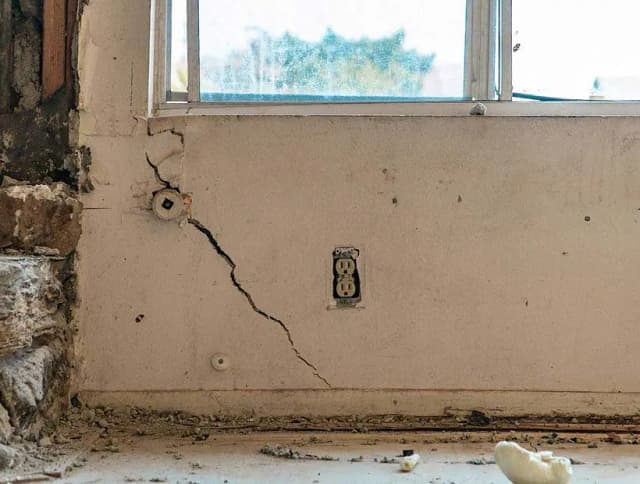
One section of the foundation sinks while the adjacent section holds, putting the wall between them in shear. The wall tears diagonally from its weakest points, usually opening corners.
Seasonal swell and shrink moves the foundation unevenly year after year. Diagonal cracks that grow through the dry season are following the clay.
Water washing soil out from under part of the foundation removes support locally, creating exactly the one-side-drops condition that produces shear cracking above.
Hillside homes half on native soil and half on fill settle along the boundary between the two, and walls crossing that line crack diagonally as the fill side drops.
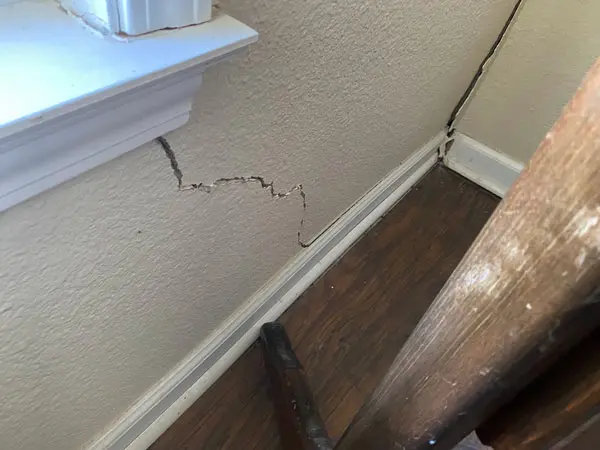
Solving diagonal cracks means addressing the underlying soil, pressure, or settlement cause. Not just patching the visible damage. Below are the engineered solutions we install most often for this symptom in California, Arizona, and Nevada homes.
If your home is showing diagonal cracks, the team you call matters. Dalinghaus crews handle foundation repair and related structural work across California, Arizona, and Nevada, and nothing else.
Foundation repair, concrete leveling, and crawl space repair are our entire focus. Not a sideline.
More than 2,000 projects on the clay and desert soils of California, Arizona, and Nevada since 2011.
CSLB License #983851 in California, ROC #330307 in Arizona, and License #0089738 in Nevada. Look us up with the state before we ever set foot on your property.
Warranty terms come in writing with every proposal, and the terms that apply to your job are stated in that job's paperwork. Ask your project specialist during the free evaluation.


Don't see your question here? Our team is happy to help. Reach out anytime.
They mean the wall is in shear: one part is moving relative to another, almost always because the foundation beneath is settling unevenly. Vertical cracks tend to be shrinkage and horizontal cracks tend to be lateral pressure, but diagonal cracks, especially ones radiating from door and window corners, point at differential foundation movement.
How a repair moves from free evaluation to completed work once diagonal cracks is diagnosed.
A local specialist walks the areas showing diagonal cracks, measures what is moving, and answers your questions on site. No cost, no obligation.
The method is matched to the cause behind the diagonal cracks, with scope and pricing in writing. No pressure in either direction.
A Dalinghaus crew corrects the movement behind the diagonal cracks, and leaves the site cleaner than we found it.
Most foundation problems show early signs. This guide shows you what to look for, what can cause it, and how a lasting repair works, before you call anyone.
Before you call anyone about diagonal cracks, read how homeowners across California and Arizona rate our work.
Share a few details and a local specialist will follow up as soon as possible to set your evaluation.
A free evaluation pins down the cause: one visit, clear findings, written estimate.